What to Do at the Scene of a Car Accident
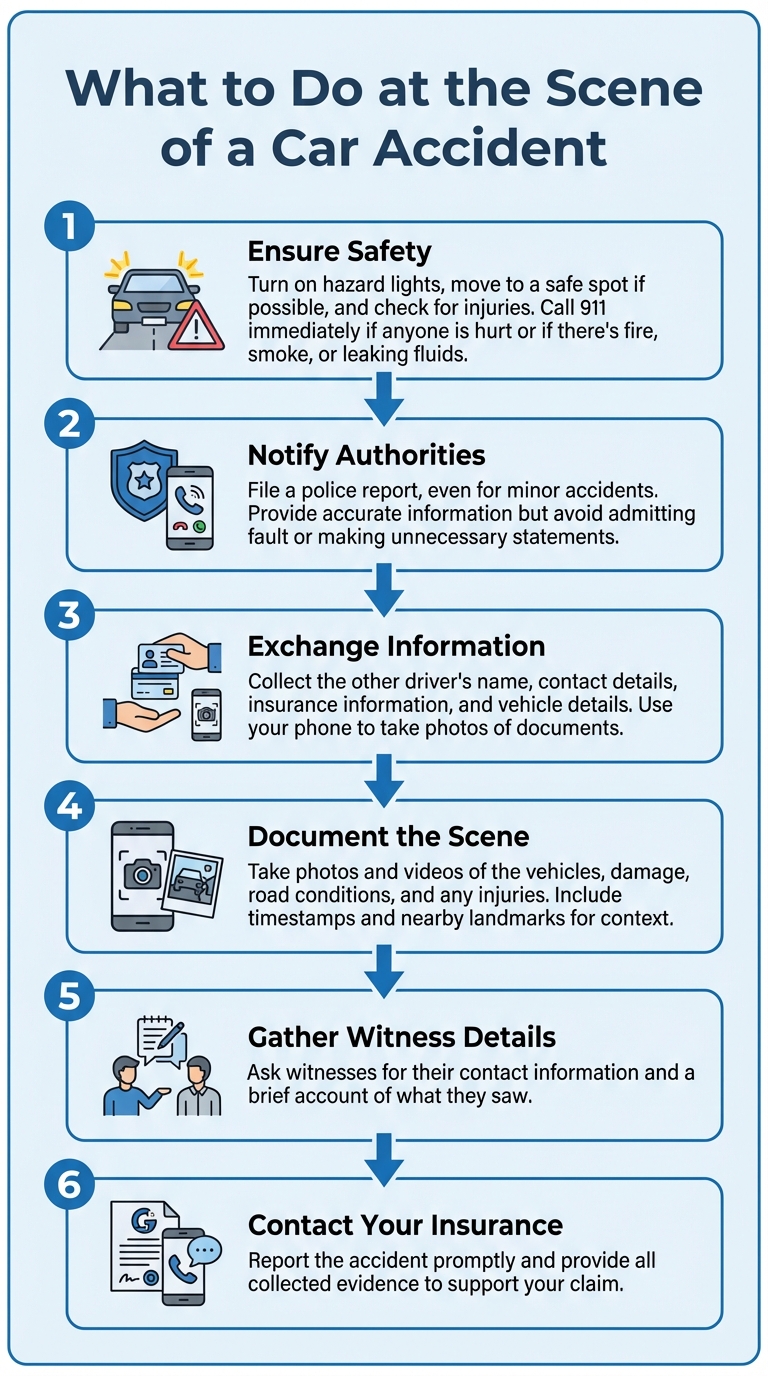
When you’re involved in a car accident, staying calm and knowing what to do can protect your safety, legal rights, and finances. Here’s a quick breakdown of the steps you should take:
- Ensure Safety: Turn on hazard lights, move to a safe spot if possible, and check for injuries. Call 911 immediately if anyone is hurt or if there’s fire, smoke, or leaking fluids.
- Notify Authorities: File a police report, even for minor accidents. Provide accurate information but avoid admitting fault or making unnecessary statements.
- Exchange Information: Collect the other driver’s name, contact details, insurance information, and vehicle details. Use your phone to take photos of documents.
- Document the Scene: Take photos and videos of the vehicles, damage, road conditions, and any injuries. Include timestamps and nearby landmarks for context.
- Gather Witness Details: Ask witnesses for their contact information and a brief account of what they saw.
- Contact Your Insurance: Report the accident promptly and file an insurance claim using your collected evidence.
Acting quickly and following these steps helps you stay safe, comply with legal requirements, and strengthen your insurance claim.
6 Essential Steps to Take at a Car Accident Scene
What To Do RIGHT AFTER a Car Accident?
sbb-itb-6a9d141
Check for Safety and Assess the Scene
The moments immediately following a crash are critical for preventing further harm. Start by checking all occupants for injuries. Keep in mind that adrenaline can mask pain, so even if you feel fine, hidden injuries could still be present.
Move to a Safe Spot If You Can
Turn on your hazard lights right away to warn other drivers. If the crash is minor, no one is hurt, and your car is still operable, carefully move it to a safer location. Once parked, engage the brake and turn off the engine.
If your car isn’t drivable and you’re on a busy road or highway, stay inside with your seatbelt on and wait for emergency services. If you need to exit the vehicle, be extremely cautious of passing traffic. Kimberly Olson from AAA Insurance advises:
"If you smell gasoline or see smoke, move as far away as safety allows".
Once you’ve ensured your surroundings are secure, assess the condition of everyone involved.
Check for Injuries and Call 911 for Medical Help
After relocating to safety, immediately check for injuries. Always call 911 without delay - don’t assume someone else has already made the call. Emergency services should be contacted if anyone is hurt, the vehicles are blocking traffic, or you notice smoke or leaking fluids.
Avoid moving anyone who is unconscious or experiencing neck or back pain unless there’s an immediate danger, such as a fire. Moving someone with a potential spinal injury can lead to permanent damage. As the Accident Support Foundation stresses:
"Your first priority after any collision is safety. If you or anyone else is injured, call 911 immediately. Do not delay emergency care for any reason".
Call Emergency Services and File a Police Report
After ensuring everyone's safety, the next step is to notify authorities and document the incident officially. Contacting law enforcement helps safeguard your legal and financial interests. A police report serves as an unbiased account of the event, which can be critical for insurance claims and legal proceedings. For more information on navigating the aftermath of a wreck, see our car accident guides. In some states, filing a report is mandatory if the property damage surpasses a specific amount - sometimes as low as $500.
When You Need to Call 911
Dial 911 if there are injuries, fire, smoke, a gasoline smell, or if the vehicles are obstructing traffic. It’s also essential to call if you suspect the other driver is impaired or is pressuring you not to involve the police. For minor accidents without injuries or immediate hazards, use the non-emergency line for your local police department.
| Situation | Recommended Action |
|---|---|
| Injuries, Fire, or Blocked Road | Call 911 immediately. |
| Suspected DUI or Hit-and-Run | Call 911 or local police dispatch. |
| Minor Damage / No Injuries | Contact the non-emergency police line or file a report at the station. |
| Other Driver is Threatening | Call 911 and move to a safe location while staying on the line. |
If police do not arrive at the scene, make sure to file a report at the nearest station or online as soon as possible.
Give Accurate Details to the Police
When the officers arrive, provide your driver’s license, vehicle registration, and proof of insurance. Clearly explain the facts of the accident, including the exact date, time, location (such as cross streets or mile markers), and the direction each vehicle was traveling. Be sure to mention any relevant conditions, like weather, road hazards, or visibility issues.
Stick to the facts and avoid giving opinions or admitting fault. As U.S. News points out:
"The side of the road is not the place to assess responsibility for the accident".
Even a simple apology can complicate your insurance claim. David Goguen, J.D., from the University of San Francisco School of Law, highlights:
"A police officer's presence at the scene - and the resulting police report - may be crucial to your car accident injury claim".
Before the officer leaves, make sure to note their name, badge number, agency, and the accident report number for your records.
Exchange Information with Other Drivers
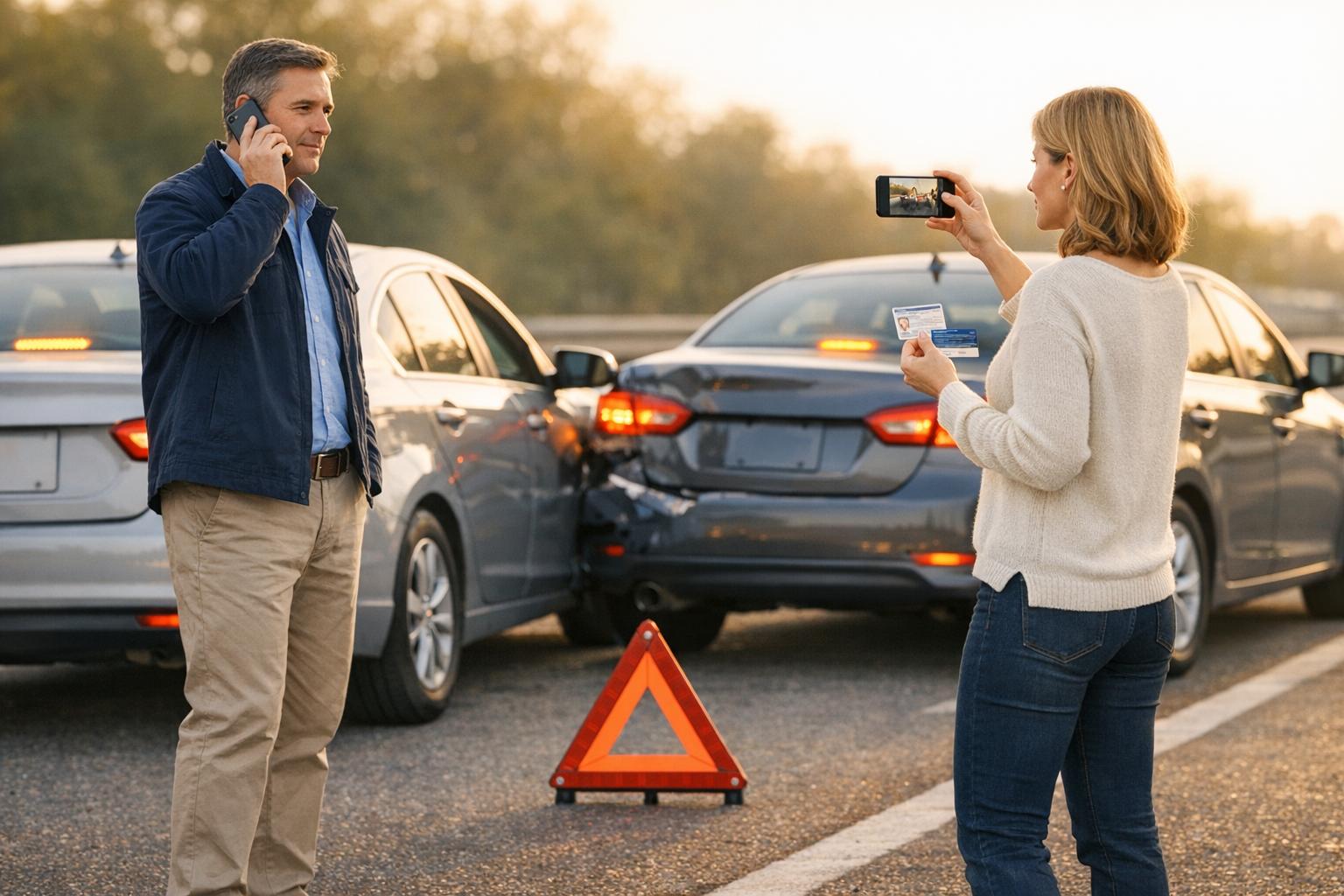
After notifying the police, the next step is exchanging details with the other drivers involved. This is crucial for creating a solid record that can protect you during the insurance claims process. A smart move? Use your smartphone to take photos of the other driver's insurance card and driver's license instead of relying on handwritten notes. This approach minimizes errors and gives you a clear, visual record of the original documents.
What Details to Collect
Here’s what you need to gather:
- Full name, phone number, and driver's license number of each driver.
- Insurance company name and policy number tied to their coverage.
- License plate number, make, model, year, and color of all vehicles involved.
- If the driver isn’t the vehicle’s owner, make sure to get the owner’s name and contact information.
Don’t stop there. Note any unique vehicle details, like bumper stickers or existing dents, that could be relevant later. Once you’ve taken photos of all documents, email or text them to yourself immediately. This ensures you have a backup in case your phone gets lost or damaged. It’s also wise to record the Vehicle Identification Number (VIN) from the dashboard or the driver’s side door jamb. The VIN helps confirm that the insurance policy matches the vehicle involved in the accident.
Extra Steps for Rideshare or Commercial Vehicles
If the accident involves a rideshare or commercial vehicle, there are additional steps to take. These situations often require more documentation because the driver may not be the registered owner. Be sure to photograph any company logos, decals, or business names visible on the vehicle. For rideshare vehicles, like those operating under Uber or Lyft, confirm which platform the driver was using at the time of the accident and understand Uber and Lyft insurance coverage. This matters because insurance coverage varies depending on whether the driver was waiting for a ride, en route, or transporting a passenger.
Additionally, collect the following:
- Business entity’s name and contact information.
- Commercial insurance company name and policy number.
As highlighted by the Accident Support Foundation:
"Attorney involvement is especially important when liability is disputed, when multiple vehicles or parties are involved, [or] when a commercial vehicle or government entity is responsible".
Commercial vehicles often have multiple layers of insurance coverage, and federal reporting standards may apply. Because of this complexity, seeking legal advice early on can be a smart move.
Document the Accident Scene
Once you've exchanged information, your next step is to thoroughly document the accident scene. This includes taking clear photos and keeping a detailed written record. Together, these pieces of evidence provide strong support for your case, offering both visual proof and precise accounts of what happened.
"Photos are the best way to paint a picture of the car accident scene and preserve visual evidence for your injury claim or lawsuit", says David Goguen, J.D., from the University of San Francisco School of Law.
This kind of documentation is especially important when dealing with insurance adjusters or if there are disputes about fault, repair costs, or the severity of injuries.
Take Photos and Videos
Your smartphone is your best tool here. Start by taking photos of all vehicles involved from three different ranges:
- Close-up shots (1–5 feet): Capture specific damage details.
- Medium range (10–15 feet): Show the points of collision.
- Long-distance or panoramic shots (20+ feet): Provide an overview of the entire scene.
Make sure to include clear images of every license plate for accurate identification.
Don’t stop with just the vehicles. Photograph the roadway, including any skid marks, shattered glass, or debris. Capture nearby traffic controls like stop signs, traffic lights, and lane markings that may have played a role in the accident. Also, document any environmental factors - like wet pavement, potholes, poor lighting, or bad weather - that could have contributed to the crash. If you or others have visible injuries, such as cuts or bruises, take photos of those as well (with consent). Enabling your phone’s timestamp function ensures the evidence is accurately dated.
If you have a dashcam, save the footage immediately. As Stacy Barrett, Attorney at UC Law San Francisco, points out:
"Dash cam footage is often the most reliable evidence of how an accident happened and who was at fault".
Including a recognizable landmark - like a tree, sign, or curb - in your photos can also help adjusters understand the scale and distance.
While visual evidence is key, a written account adds another layer of detail.
Write Down What Happened
Don’t rely solely on memory. Write down your recollections of the accident as soon as possible. As David Goguen, J.D., recommends:
"Start a personal journal in which you record your recollections about the accident and your injuries (including the impact they are having on your emotional health and your daily activities)".
Make sure to include specifics like the positions of the vehicles, the exact location, time, weather, and road conditions.
It’s also smart to keep a pad and pen in your car as a backup in case your phone isn’t working. Write down even small details about how you feel physically - like stiffness or anything that feels "off." Injuries often show up later, and these notes could be critical for medical claims. This written record complements your photos by capturing details that images alone can’t convey and can be a valuable reference during insurance discussions or legal proceedings.
Collect Witness Information
After documenting the scene with photos and notes, the next step is gathering witness information. Witness statements can play a key role in determining fault and resolving disputes, especially if the other driver denies responsibility or provides a conflicting version of events. As David Goguen, J.D., from the University of San Francisco School of Law, points out:
"Statements from witnesses can also become key evidence later on, in any lawsuit or insurance claim that seeks to establish legal responsibility -- in other words, when it comes to proving fault for a car accident".
Time is critical here - witnesses often leave the scene quickly. Approach them as soon as it’s safe to do so.
Get Contact Details from Witnesses
Look for neutral bystanders like pedestrians, cyclists, or uninvolved drivers. You might also check nearby homes or businesses for people who may have observed the accident. Neutral witnesses - those without personal ties to anyone involved - tend to be viewed as more trustworthy by insurance companies and courts.
When approaching witnesses, remain calm and polite. Introduce yourself and ask if they saw what happened. If they did, request their full name, phone number, and email address. Also, ask if they’d be open to being contacted later by an insurance company or attorney. At this stage, prioritize gathering their contact information rather than conducting a detailed interview - accident scenes are often too chaotic for lengthy conversations.
Don’t overlook potential "digital witnesses" either. Look around for surveillance cameras or doorbell cameras that might have recorded the incident. Ask witnesses if they know who owns these cameras or how to access the footage. Once you’ve secured contact details, move on to recording their statements.
Record What Witnesses Say
After gathering contact information, ask witnesses for a brief account of what they observed. Use open-ended questions like, "Can you describe what you saw?" and focus on factual details such as their location, road conditions, and any unusual observations. For example, did they notice a vehicle swerving or a driver using their phone?
Document their statements immediately, either by writing them down or using your phone. If the witness agrees, you can also record their account - but make sure to get their explicit permission first. Some states, like Delaware, require all parties to consent to being recorded. Once they’ve finished, repeat their main points back to them to confirm accuracy and avoid misunderstandings.
If a witness has photos or videos of the accident, ask if they’re willing to share them. You can also request a quick sketch or written summary of vehicle positions if they’re comfortable providing one. Stick to what the witness directly observed - don’t record secondhand information, as it’s often considered inadmissible "hearsay" in court. Combining these witness accounts with your own documentation creates a strong foundation for insurance claims or legal proceedings.
Report to Your Insurance Company and Get Expert Help
After documenting the accident and gathering witness details, the next step is to notify your insurance company and seek professional guidance.
File Your Insurance Claim Right Away
Once you’ve safely left the scene, contact your insurance provider as soon as possible. Most policies require prompt notification of any incidents that might involve coverage. Attorney Stacy Barrett emphasizes this point:
"Your policy requires you to promptly notify your insurance company of any incident that could trigger coverage. Failure to provide timely notice to your car insurance company could jeopardize your coverage."
When reporting the accident, stick to the facts: explain what happened, where and when it occurred, who was involved, and the damage you observed. Avoid guessing or assigning blame - if you’re unsure about something, it’s fine to admit it. Provide any photos, witness contact information, and the police report number you collected at the scene. Many insurers offer mobile apps or online portals that allow you to file claims quickly and efficiently. Once submitted, an adjuster will be assigned to guide you through inspections and repair options.
Get Help from Collision Help
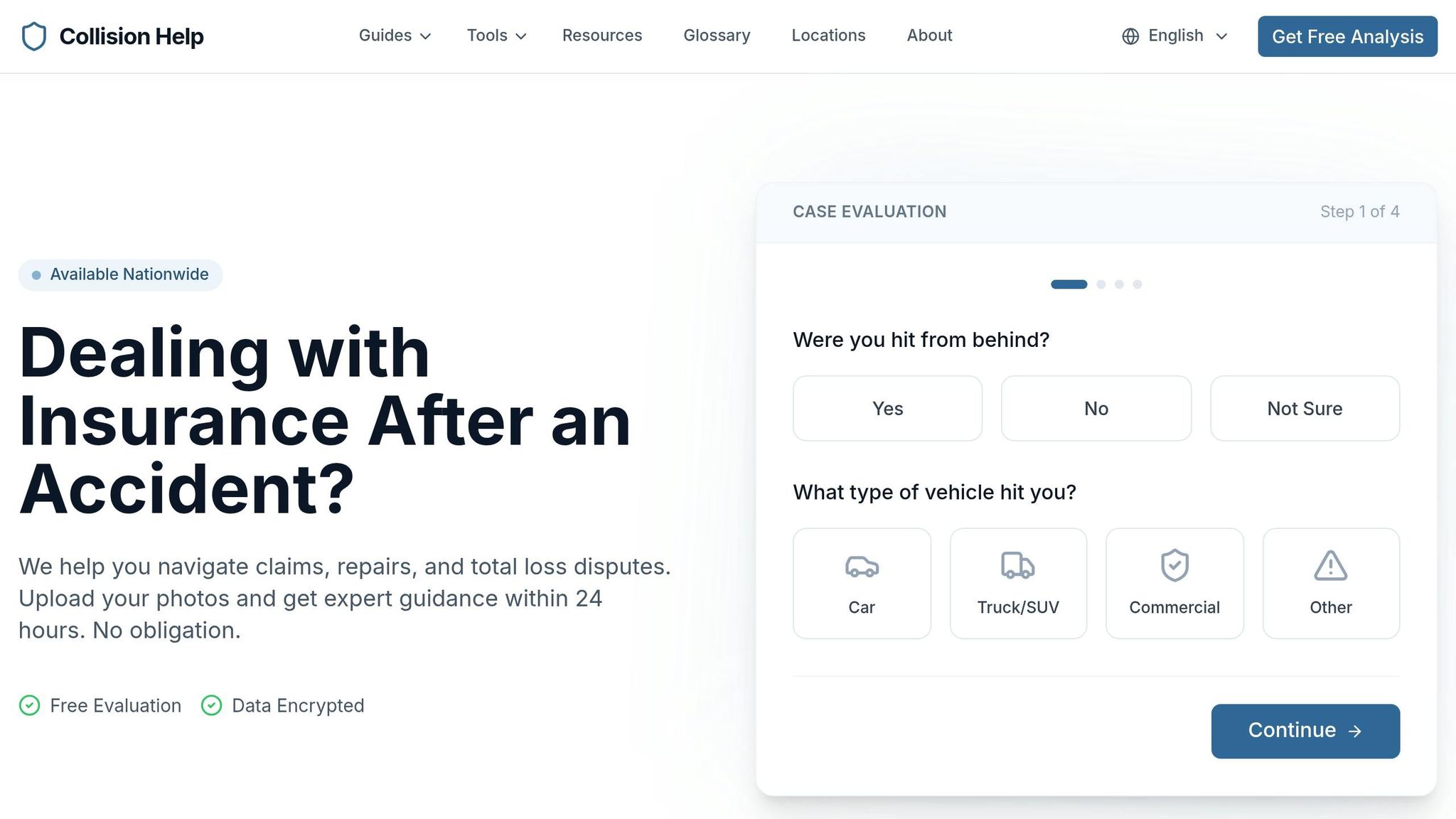
Dealing with insurance claims, repair estimates, and disputes over total losses can feel overwhelming - especially when injuries or significant vehicle damage are involved. This is where Collision Help steps in to simplify the process. Their secure platform lets you upload photos of your vehicle’s damage and receive expert advice within 24 hours. They’ll help you navigate coverage details, coordinate with repair shops, and manage approvals for additional repairs if hidden damage is found.
If your car is declared a total loss, Collision Help can assess whether your settlement fairly reflects the market value of your vehicle, including taxes and transfer fees. They also provide access to Car Accident Lawyers on a contingency basis, which can be especially helpful if there’s a dispute over fault or if the other party’s insurer denies payment. Statistics show that claimants who work with legal professionals secure compensation 74% of the time, compared to 54% for those who handle claims alone. Additionally, the average payout for those with legal assistance is $44,600, compared to $13,900 for those without. This kind of support ensures you’re not left to handle the claims process on your own during an already stressful situation.
Conclusion
Taking the right steps after a car accident - like ensuring safety, documenting the scene, and notifying the proper authorities - can make a challenging situation much easier to manage. Accidents are overwhelming, but acting quickly and correctly helps protect your health, legal rights, and finances. Start by prioritizing safety: move to a secure location if it's possible, check for injuries, and call 911 if medical assistance is needed. Be sure to exchange necessary details with the other drivers, but avoid making statements like apologizing or admitting fault, as these could complicate your claim later on. Capture detailed documentation of the scene, including photos, and gather witness contact information before they leave.
After leaving the scene, contact your insurance company as soon as possible and provide them with all the evidence you’ve collected. In states like California, you may also need to file an official accident report with the DMV within 10 days if injuries occurred or property damage exceeds $750. Reporting promptly not only complies with your policy but also helps prevent any issues with claim denials.
For cases involving significant damage, injuries, or disputes over total loss, Collision Help offers free evaluations and connects you with experienced Car Accident Lawyers. These lawyers work on a contingency basis, meaning you won’t pay unless they secure a recovery for you. By taking these clear and decisive steps, you can better protect yourself, streamline the claims process, and get the support you need during recovery.
FAQs
Should I move my car after a crash?
If you're involved in a car accident, whether or not to move your vehicle depends on the circumstances. For minor accidents where it's safe to do so, moving your car to a secure location, like the shoulder of the road, can help avoid additional accidents. However, if there are injuries or significant damage, focus on safety first and contact emergency services immediately. Always stay at the scene until law enforcement gives you the go-ahead to leave. Be sure to document the incident carefully for insurance purposes and official reports.
What if the police don’t come to the scene?
If the police don’t make it to the accident scene, your first step should be ensuring everyone’s safety. Once it’s safe, document the situation as thoroughly as possible. Snap photos of the damage, exchange contact and insurance details with the other parties involved, and jot down important facts about the accident, like the time, location, and weather conditions. While having a police report is helpful, in some states, you may need to report the incident to authorities yourself later. Make sure you collect enough evidence to handle any future steps smoothly.
When should I get help from Collision Help | Nationwide Accident Help?
If you've been in an accident and need help with insurance claims, repair decisions, or total loss disputes, Collision Help | Nationwide Accident Help is here to assist. This platform offers support across the country, making it easier to handle the aftermath of an accident. You can securely upload photos of your vehicle's damage and receive expert advice within 24 hours. It's a valuable resource for tackling complicated post-accident processes, like dealing with insurance or resolving disputes.