Best Ways to Document Vehicle Damage After a Crash
After a car accident, documenting vehicle damage thoroughly is essential for filing an insurance claim and avoiding disputes. Here's what you need to do:
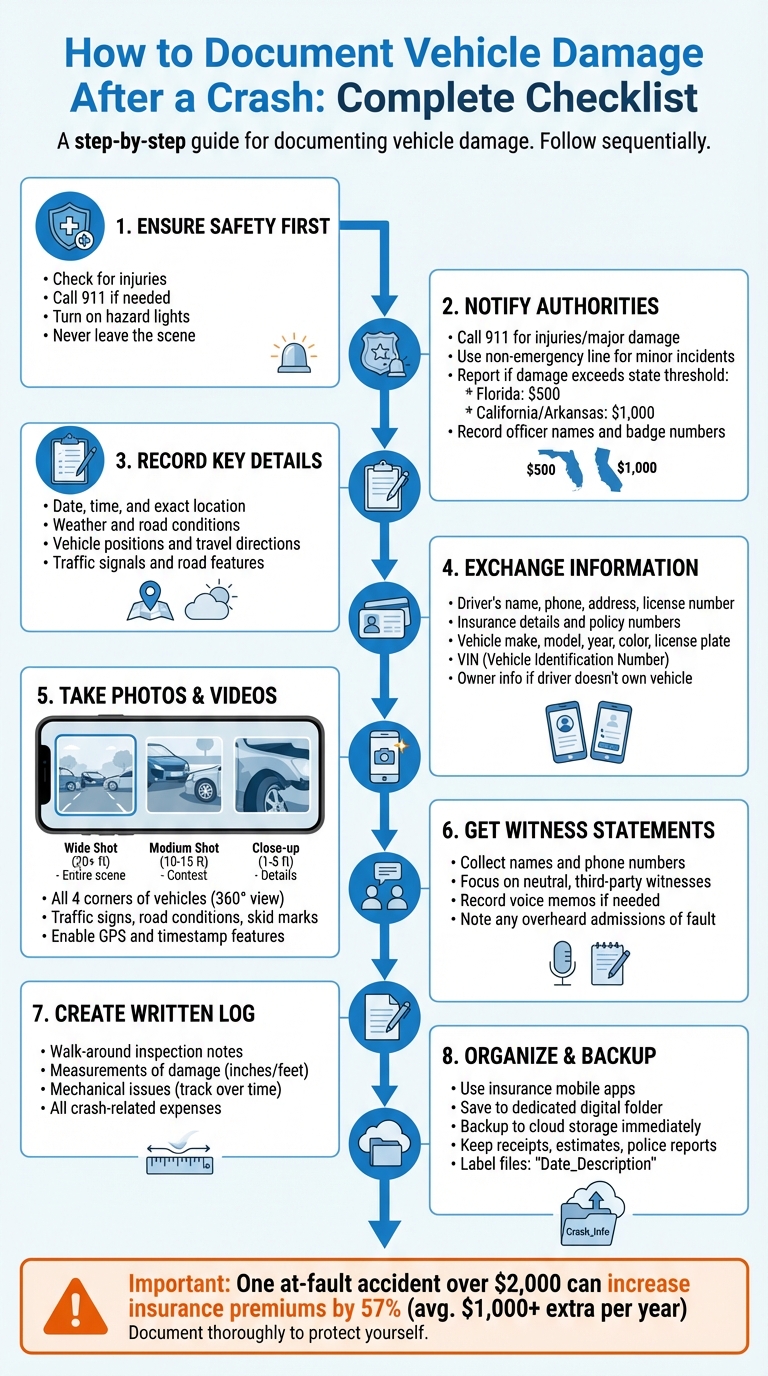
- Ensure Safety First: Check for injuries, call 911 if needed, and never leave the accident scene.
- Notify Authorities: Report the crash to police if damage exceeds state thresholds (e.g., $1,000 in California).
- Record Key Details: Note the date, time, location, weather, road conditions, and vehicle positions.
- Exchange Information: Collect names, contact info, insurance details, license plate numbers, and VINs.
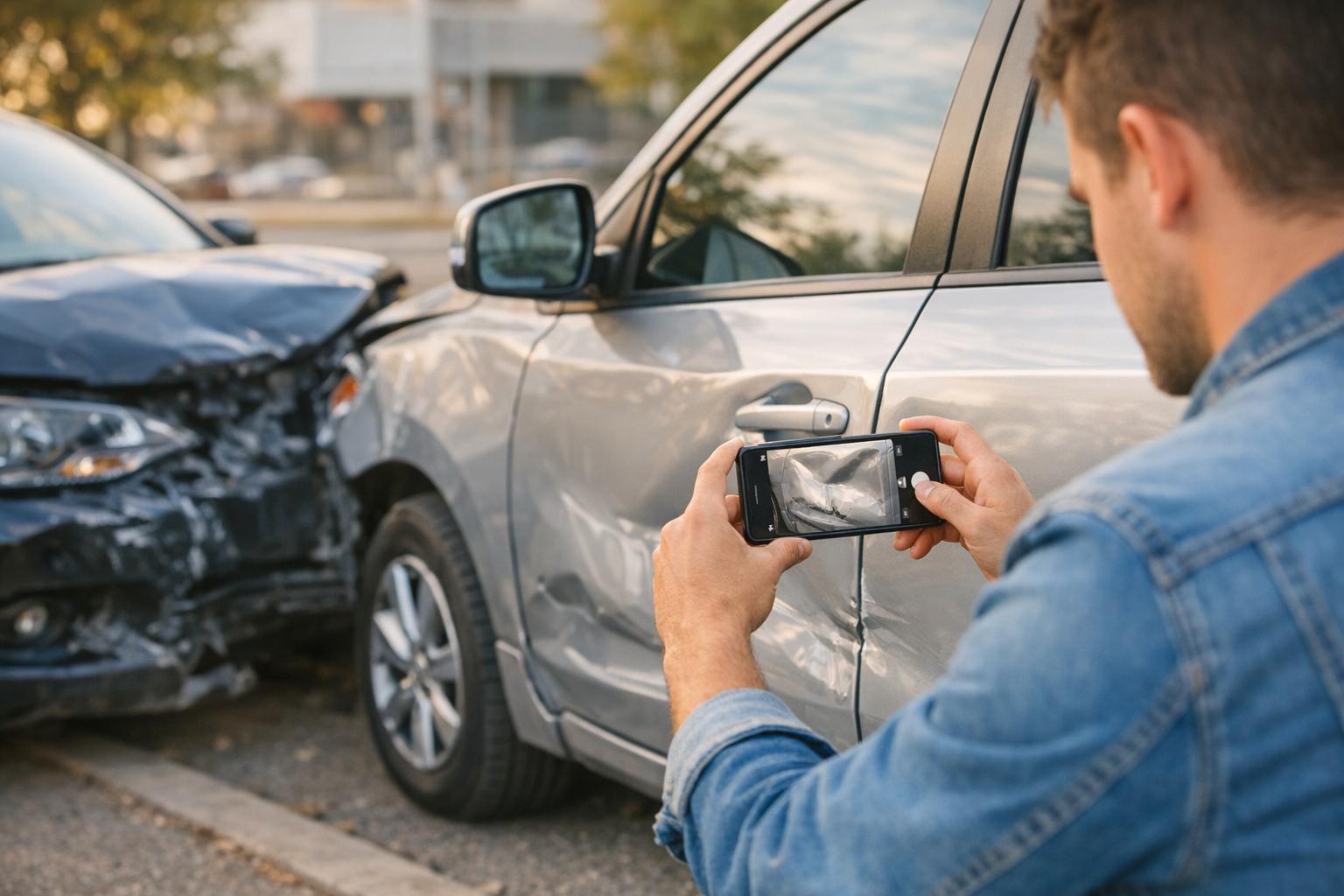
- Take Photos and Videos: Capture wide, medium, and close-up shots of the scene, vehicle damage, and surroundings. Use timestamps and GPS features on your smartphone.
- Get Witness Statements: Gather names and contact details of neutral witnesses who saw the accident.
- Maintain a Written Log: Document visible damage, mechanical issues, repair estimates, and crash-related expenses.
- Use Technology: Many insurance apps guide you through submitting photos and tracking claims.
Proper documentation can save you money, time, and stress during the claims process. Follow these steps to strengthen your case and ensure a smoother resolution.
Step-by-Step Guide to Documenting Vehicle Damage After a Car Accident
What Should I Document After A Minor Accident?
Safety and Legal Steps Before Documenting Damage
Your first priority after an accident should always be safety. Check for injuries and call 911 if necessary before focusing on documenting any damage.
Ensure Safety and Notify Authorities
Turn on your hazard lights to alert other drivers and make it easier for emergency responders to locate you. If it’s unsafe to leave your vehicle, stay inside with your seatbelt fastened. Never leave the scene of an accident, no matter how minor it seems - doing so can lead to serious legal trouble.
For accidents involving injuries or significant damage, call 911 immediately. For minor incidents, use the local non-emergency line. Be sure to report the accident if the damage exceeds your state’s threshold (commonly around $1,000; for example, Florida: $500, California/Arkansas: $1,000). If police officers arrive, record their names, badge numbers, and any instructions they provide about filing a report.
Avoid admitting fault or making promises to pay for damages, as these statements could hurt your claim later on.
Once safety is addressed, start gathering details at the scene to strengthen your claim.
Deciding Whether to Move Vehicles or Leave Them in Place
If your vehicle is obstructing traffic but can be moved safely, reposition it to reduce the risk of further accidents. However, if moving the vehicle isn’t safe, it’s best to wait for assistance.
Before moving any vehicles, take photos of the scene to capture their original positions. If relocation is necessary to avoid hazards, document the new positions using recognizable landmarks, street signs, or skid marks. Always follow instructions from 911 operators or police officers when deciding how to proceed.
Information to Record at the Scene
Once everyone's safety is confirmed, it’s time to document everything you can about the incident. Detailed records not only strengthen your insurance claim but also provide vital context for the photos and videos you’ll capture.
Record Incident Details
Start by noting the exact date and time of the collision - your smartphone's timestamp can help with accuracy. Include the precise location, whether it’s a specific address, cross streets, highway mile markers, or nearby landmarks. Don’t forget to describe the direction each vehicle was traveling, as well as the weather conditions, road surface (wet, icy, or dry), and any traffic signals or road features that might have played a role in the crash.
Collect Other Parties' Information
Gather the full name, phone number, and address of every driver involved. Be sure to note their driver's license number and the state where it was issued. To avoid errors, take clear photos of their driver's license and insurance card.
For each vehicle, record its make, model, year, color, and license plate number. Don’t overlook the Vehicle Identification Number (VIN), which is typically located at the base of the driver’s side windshield. If the driver isn’t the vehicle owner, make sure to collect the owner’s name, contact information, and insurance details as well. Additionally, ask for the names and contact information of any passengers in the other vehicles.
Get Witness Information
After gathering details about the incident and other drivers, look for witnesses who can provide an unbiased account of what happened. Witnesses could include pedestrians, cyclists, passengers in uninvolved vehicles, or even nearby employees or customers who saw the crash. Collect their names and phone numbers promptly, as bystanders are not required to stay at the scene.
Neutral witnesses - those without any connection to the drivers - are especially valuable to insurance adjusters. They may also overhear critical statements from the at-fault driver, such as "I didn’t see you" or "I was checking a text", which can be crucial for proving liability. This is especially complex in a multi-vehicle accident where fault may be split among several parties. If a witness is in a rush, ask if you can record a quick voice memo or video of their account on your smartphone.
"Independent, third-party witness statements carry a lot of weight with insurance adjusters because the witness has no personal or financial interest in your claim." - Charles R. Gueli, Esq., Licensed Attorney
With these records in hand, you’ll be ready to move on to capturing visual evidence through photos and videos.
How to Take Photos and Videos
Capturing clear photos and videos is essential for documenting the extent of damage and supporting your insurance claim. Your smartphone can be your best ally at the scene if you know how to use it effectively. These visuals help create a detailed record of the accident, providing crucial evidence for the claims process.
Wide, Medium, and Close-Up Shots
Begin by taking wide-angle shots from at least 20 feet away to capture the entire accident scene before any vehicles are moved. These photos give an overview of the road layout, lane positions, and the final resting spots of the vehicles involved. Once you've established the big picture, move closer - about 10 to 15 feet - to take medium-range shots. These images should show the damage in relation to the whole vehicle, providing context for how and where the impact occurred.
"Start by taking wide-angle shots from a distance that show the entire accident scene. Once you've captured the overall scene, concentrate on taking clear photos of the damage to all vehicles involved."
- Leah Hancock, Material Damage Reinspector, Erie Insurance
Next, focus on close-up shots from 1 to 5 feet away to highlight specific details like dents, scratches, broken parts, or paint transfer. Stand around 2 feet away and use your phone's zoom feature to avoid distortion and maintain clarity. Include identifying details such as license plates or the VIN, which is usually located at the base of the driver-side windshield, to ensure the photos are tied to the correct vehicle. For dark-colored cars, where damage might be harder to spot, consider marking the dent or scratch with tape or a washable marker before photographing.
"The more photos you take, the more helpful you can be."
- Leah Hancock, Material Damage Reinspector, Erie Insurance
Don't forget to follow the four-corner rule: photograph all sides of the vehicles to provide a complete 360-degree view.
Photograph the Surrounding Environment
The scene's surroundings are just as important as the vehicle damage. Take photos of traffic lights, stop signs, and street signs to pinpoint the accident's location and highlight any traffic violations. Road conditions - like potholes, wet pavement, ice, or debris - can also be critical to understanding what happened, so make sure to document them.
Capture any temporary evidence, such as skid marks, broken glass, car parts, or fluid trails. Including a fixed landmark, like a street sign or curb, in your frame can help establish scale and distance. If there’s damage to nearby structures like guardrails, fences, or utility poles, be sure to photograph those as well.
Use Smartphone Features for Accuracy
Before arriving at the scene, make sure your phone's camera settings have the time and date stamp enabled, along with location services (GPS). These features embed metadata into your photos, recording the exact time, date, and location of each shot - critical details for your claim. Avoid editing or applying filters to your photos, as this can alter the metadata.
Use your smartphone’s video function to slowly pan across the accident scene, capturing details like the flow of traffic and the timing of traffic lights. Video can also record sound, which is useful for capturing witness statements or any admissions of fault. If you’re too shaken to write down details immediately, you can record a voice memo describing the weather, road conditions, and what you experienced during the crash.
Once you’ve taken your photos and videos, back them up right away by emailing them to yourself or uploading them to cloud storage. This preserves the original timestamps and ensures you have a secure copy. If your phone doesn’t show a visible timestamp, take a photo of another device displaying the correct time and date alongside the accident scene.
With your visual evidence safely stored, you can move on to documenting the damage in writing.
sbb-itb-6a9d141
Creating a Written Damage Log
While photos capture the visual impact of an accident, a written damage log provides the crucial context behind the images. This log becomes your detailed narrative, recording everything from visible dents to mechanical issues that may arise days after the incident. Together with photos, it strengthens your claim by painting a complete picture of the damage.
"A car accident journal can be helpful when you have to explain your damages to an adjuster or jury. You may think you'll never forget the details... but memories fade."
- David Goguen, J.D., University of San Francisco School of Law
Perform a Walk-Around Inspection
Start by inspecting your vehicle from every angle. Pay close attention to weather conditions (like rain, fog, or snow) and road conditions (such as potholes or icy patches) that may have contributed to the crash. Note any visible markings or measurements from the scene.
For each area of damage, record specifics like impact points, paint transfers, shattered glass, or debris. Whenever possible, include measurements - for example, the size of a dent in inches or the length of a scratch in feet. Don’t forget to document damage to nearby objects, such as guardrails, fences, or utility poles.
Track Mechanical Issues After the Crash
Mechanical problems might not show up immediately after an accident. Over the following days, keep an eye (and ear) out for new issues. Record the date and details of any symptoms, such as grinding noises when braking, dashboard warning lights, or changes in steering.
This record can help establish a direct connection between the crash and these problems, making it harder for insurers to argue that the issues were pre-existing. For example, if your car starts pulling to one side or vibrating at certain speeds, make a note of it in your log.
Keep All Supporting Records
Create a dedicated folder - either physical or digital - to organize every document related to the accident. Include key details like the police report number, the responding officer’s name and badge number, and the agency they represent. Collect multiple repair estimates (two or three is ideal) to compare with the valuation provided by your insurance adjuster.
Save receipts for all crash-related expenses, such as towing fees, vehicle storage costs, rental car invoices, or even rideshare and public transit expenses while your car is out of commission. If the accident affects your ability to work, keep records like pay stubs or time sheets to document lost wages. Additionally, maintain a log of all communications with insurance adjusters, body shops, and towing companies. Record the date, the person’s name, and a brief summary of each conversation. This level of organization ensures your claim is backed by thorough documentation.
Using Digital Tools and Expert Help
These days, technology makes it easier than ever to handle insurance claims. By using digital tools, you can submit photos and get repair estimates in just a few hours. These tools help you capture all the details insurers need while keeping your records organized.
Use Insurance Apps and Photo Checklists
Many insurance companies now offer mobile apps that simplify the claims process. These apps guide you through taking the right photos, uploading documents, and even tracking your claim status in real time. For example, Erie Insurance provides a web-based photo appraisal tool that’s accessible via a simple text or email link.
"ERIE's photo appraisal tool allows the customer to submit photos quickly and conveniently through their device's web browser and receive an estimate. It's super easy to use!"
- Leah Hancock, Material Damage Reinspector at Erie Insurance
These tools often include step-by-step instructions to capture wide, medium, and close-up shots. This ensures you provide all the necessary angles adjusters need to assess your claim. Additionally, the photo metadata - like timestamps and GPS location - serves as solid evidence of when and where the accident occurred, making your claim harder to dispute.
Get Expert Help with Collision Help
While apps can make the process easier, claims can still get complicated. This is where expert guidance comes in handy. Collision Help, for instance, allows you to upload damage photos and receive professional advice within 24 hours. Their team reviews your documentation and provides a tailored plan for managing repairs and insurance claims. This free evaluation can help you spot any gaps in your paperwork before submitting it to your insurer, potentially avoiding delays or disputes.
"The fact is, insurance companies don't make large payouts on weak claims."
- Charles R. Gueli, Esq., a licensed attorney
Combining expert analysis with detailed photos and a thorough written log can significantly strengthen your claim.
Organize Digital Records
To keep everything in order, consider creating a dedicated folder on your phone or computer specifically for the accident. Clearly label each file with the date and a brief description, like "01-09-2026_RearBumper_Damage" or "01-09-2026_Police_Report". This organization makes it easy to find specific documents when your adjuster asks for them. Don’t forget to back up all your originals to cloud storage right away to ensure you have copies in case something gets lost.
Conclusion
Documenting vehicle damage after a crash is crucial for protecting your wallet and ensuring the claims process goes smoothly. Here's a stark reminder: just one at-fault property damage accident costing over $2,000 can hike your annual insurance premiums by an average of 57%, which could mean paying more than $1,000 extra each year.
Start by prioritizing safety, then focus on gathering thorough evidence. Take clear photos and videos of the scene, exchange complete information with everyone involved, collect witness contacts, and keep a detailed written log. Make sure to organize receipts, police reports, and repair estimates in a digital folder, preferably with cloud storage as a backup.
Digital tools, like insurance mobile apps, can make the process faster, but when things get tricky, expert advice can be a game-changer. Attorney Charles R. Gueli, Esq. emphasizes:
"A skilled personal injury attorney knows how to deal with the insurance company, the other driver's attorney, and the courts to help you get the full compensation you deserve."
Services like Collision Help step in to make things even easier. They offer free evaluations within 24 hours, reviewing your documentation to spot any gaps before you submit it to your insurer. This extra step can help you avoid expensive delays or disputes.
FAQs
What should I do if there are no witnesses to my car accident?
If no one witnessed your accident, documenting the scene thoroughly becomes even more important. Start by snapping clear, high-resolution photos of the vehicle damage from multiple angles. Don’t forget to capture the surrounding area, including road conditions, traffic signs, skid marks, and any debris. Jot down key details like the date, time (e.g., 01/08/2026, 09:45 AM), weather conditions, and a brief account of what happened while it’s still fresh in your memory. Using a smartphone checklist or an accident documentation app can make this process easier and ensure you don’t overlook anything.
Make sure to contact the police to file an official report, even if the accident appears minor. If an officer arrives at the scene, ask for their name, badge number, and the report number, and request a copy when it becomes available. If no officer is dispatched, you can file a report yourself at the local police department or online, usually within a set time frame (often 24 hours).
Additionally, look around for surveillance cameras or dash-cams that might have captured the accident. Save all related documents, such as receipts for towing or repairs, and submit everything to your insurance company as soon as possible. These steps can help build a strong claim, even without eyewitnesses.
What’s the best way to take photos and videos of vehicle damage for an insurance claim?
To make sure your photos and videos meet insurance requirements, aim to capture clear, detailed, and accurate evidence of the damage. Start by photographing both vehicles involved, focusing on the points of impact, any skid marks, and the surrounding area. Take wide shots to show the overall scene and close-ups to highlight specific damage, such as dents or scratches. Good lighting is key - daylight or a well-lit area works best - and keep your phone steady to avoid blurry images.
A short video walkthrough can add extra clarity. As you record, narrate what you're seeing, like, "The front-left bumper has a noticeable dent." This provides additional context for the damage. Make sure to keep the original files untouched to retain metadata, including timestamps, dates (formatted as MM/DD/YYYY), and location details. Insurers often use this information to verify claims. Following these steps ensures you’ll have a solid visual record to support your case.
What details should I include in a damage log after a car accident?
After a car accident, it’s crucial to keep a detailed record of the incident to avoid any confusion later. Start by noting the date, time, and exact location of the crash. Document the damage to all vehicles, including their make, model, year, color, and VIN (Vehicle Identification Number). Be sure to gather the names, contact information, license plate numbers, and insurance details of all drivers involved, as well as your own driver’s license and insurance policy information.
If police are on the scene, write down the officer’s name and badge number. Also, take note of any conditions that might have contributed to the accident, like the weather, road surface, skid marks, or debris. Keeping everything well-organized will make filing an insurance claim much smoother and help prevent potential disputes down the line.