Best Practices for Repair Warranty Claims
When dealing with repair warranty claims, understanding your rights and following the proper steps can save you time, money, and frustration. A repair warranty ensures that the quality of repair work after an accident meets proper standards, covering issues like defective parts or poor workmanship. Here's what you need to know:
- Types of Warranties: Options include short-term warranties (12 months/12,000 miles), limited lifetime warranties (valid as long as you own the car), and manufacturer warranties (covering factory defects).
- What's Covered: Most repair warranties cover parts, labor, paint defects, and workmanship issues. Exclusions often include wear-and-tear items, damage from neglect, or vehicle modifications.
-
Filing a Claim:
- Review your warranty terms.
- Document the issue with photos, videos, and receipts.
- Contact the repair shop and warranty provider for pre-authorization.
- Schedule an inspection before repairs begin.
- Track your claim and keep all records.
- Avoiding Denials: Common reasons for claim denials include lack of maintenance records, unauthorized repairs, pre-existing conditions, or modifications. Keep detailed service records and follow warranty guidelines to prevent issues.
If your claim is denied, request a written explanation, gather evidence, and file an appeal. For unresolved disputes, consider contacting consumer protection agencies or seeking legal advice. Staying organized and proactive ensures smoother warranty claim processes.
How To File An Extended Warranty Claim? - Customer Support Coach
sbb-itb-6a9d141
Repair Warranty Basics
Knowing what a repair warranty covers - and what it doesn’t - can help you avoid unexpected costs. For accident repairs, the shop’s warranty focuses on the quality of the repair work and operates separately from your insurance claim.
Types of Repair Warranties
Collision repair shops offer various warranty options, and understanding these can guide you in selecting the right shop.
Basic or short-term warranties typically cover specific repair work and parts for a limited duration, such as 12 months or 12,000 miles. While straightforward, they’re time-restricted.
Limited lifetime warranties are the most common among national chains. These cover workmanship and parts for as long as you own the car. However, the term "lifetime" can be misleading. According to Texas Collision Centers, "Lifetime collision repair warranties typically only cover work while you own the vehicle and don't transfer to new owners". In fact, 80% of car owners express uncertainty about the true scope of these warranties.
Comprehensive shop warranties go further by covering issues like labor, paint defects (peeling or cracking), frame straightening, and other problems that may arise later.
| Warranty Type | Typical Coverage | Duration | Transferable? |
|---|---|---|---|
| Basic Shop | Parts and specific labor | 12 months / 12,000 miles | No |
| Limited Lifetime | Workmanship, paint, and body parts | Duration of vehicle ownership | No |
| Manufacturer | Factory defects, powertrain | 3-10 years / 36k-100k miles | Yes |
| Extended (VSC) | Mechanical/Electrical breakdowns | Varies by contract | Sometimes |
Always ask for warranty terms in writing immediately after the repair. Clarify whether the warranty can transfer to a new owner - most collision repair warranties don’t. Having these details upfront ensures smoother warranty claims down the road.
Now that the types are clear, let’s dive into what these warranties generally cover.
What Repair Warranties Cover
A good repair warranty should cover both parts and labor. This includes replacement parts and the work needed to install them, although some shops may impose limits on labor rates. Coverage often extends to workmanship defects, paint issues (peeling, cracking, or fading), misaligned panels, and faulty parts used during the repair.
For instance, if your bumper’s paint starts peeling within a few months, the warranty should cover repainting. Similarly, if a replaced door doesn’t align properly or causes wind noise, the shop is responsible for fixing it under the warranty.
Federal law also offers extra protection through the Magnuson-Moss Warranty Act. This legislation ensures that routine maintenance by independent mechanics won’t void your vehicle’s factory warranty - provided the work is done correctly and records are kept. This means you can take your car to any qualified mechanic without worrying about losing warranty coverage.
Common Warranty Exclusions
Even the most comprehensive warranties have limitations. Most collision repair warranties exclude wear-and-tear items like brake pads, tires, and wiper blades, as well as damage caused by subsequent accidents or environmental factors like rust, corrosion, sun fading, or chemical exposure.
Improper vehicle maintenance is another common exclusion. If you skip oil changes or fail to follow the manufacturer’s maintenance schedule, the shop can deny your warranty claim. Keeping detailed service records - such as oil changes, tire rotations, and fluid checks - is essential for protecting your warranty.
Unauthorized modifications also pose a risk. Adding aftermarket parts, such as lift kits or performance upgrades, can void parts of your warranty if the shop determines that the modification caused the issue. Before making any changes to your repaired vehicle, verify how they might impact your warranty coverage. Understanding these exclusions is crucial for navigating the claims process successfully.
How to File a Repair Warranty Claim
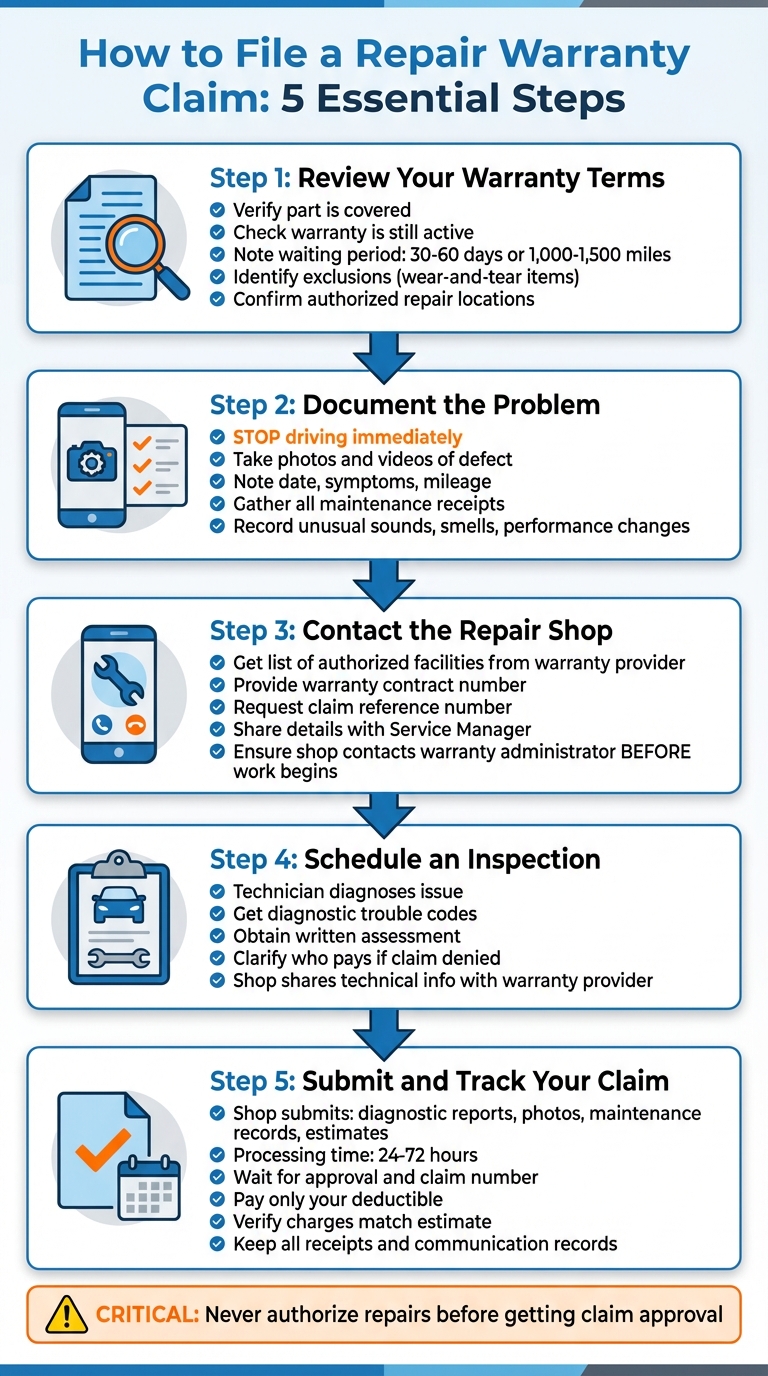
5-Step Process for Filing a Repair Warranty Claim
Filing a repair warranty claim doesn’t have to be complicated, especially if you secure pre-authorization before any work begins. Here’s a step-by-step guide to help you navigate the insurance claim filing process smoothly.
Step 1: Review Your Warranty Terms
Start by carefully reviewing your warranty paperwork to ensure the part in question is covered and that your warranty is still active. Many third-party warranties include a waiting period - typically 30 to 60 days and 1,000 to 1,500 miles - before coverage kicks in. Be aware of any exclusions, such as wear-and-tear items like brake pads or wipers, or damage caused by neglect. Some warranties, like Mopar warranties, may require repairs to be done at specific locations, such as Mopar dealerships. Knowing these details upfront can save you from headaches later.
Step 2: Document the Problem
Once you’ve confirmed coverage, document the issue right away. If a problem arises, stop driving immediately, as continuing to operate a failing vehicle could result in your claim being denied for "continued operation". Take photos or videos of the defect and note when the issue began, any unusual symptoms (like strange sounds, smells, or performance changes), and the vehicle’s current mileage. Additionally, gather all maintenance receipts - such as records for oil changes, inspections, and filter replacements - as these may be required to prove the failure wasn’t due to neglect.
Step 3: Contact the Repair Shop
Next, reach out to your warranty provider to get a list of authorized repair facilities. Provide your warranty contract number and request a claim reference number. When you arrive at the repair shop, share your warranty contract details with the Service Manager and ensure they contact the warranty administrator for authorization before any work begins.
Step 4: Schedule an Inspection
The repair shop’s technician will diagnose the issue and provide diagnostic trouble codes along with a written assessment of the root cause. If disassembly is necessary, clarify in advance who will cover the labor costs if the claim is denied. The Service Manager will then share this technical information with the warranty provider to get approval for the repairs.
Step 5: Submit and Track Your Claim
Once the shop submits your claim - including diagnostic reports, photos, maintenance records, and repair estimates - most warranty claims are processed within 24 to 72 hours. Avoid authorizing any work until the warranty administrator has approved the claim and issued a claim number. Typically, you’ll only need to pay your deductible directly to the shop. Before making any payments, double-check that the authorized charges match the final estimate. Keep all receipts and record any communication details for your records.
Why Warranty Claims Get Denied and How to Prevent It
Understanding why repair warranty claims are denied can save you both money and a lot of frustration. Most denials result from avoidable mistakes rather than actual gaps in coverage. Let’s break down the most common reasons and how you can avoid them.
One major reason for denial is maintenance neglect. If you can’t provide proof of regular oil changes, fluid flushes, or filter replacements, warranty providers might assume that poor upkeep - not a defect - caused the issue. Another common issue is unauthorized repairs. If a repair shop starts work - like tearing down an engine - before getting an authorization number from the warranty provider, your claim is likely to be denied. Similarly, pre-existing conditions, or issues that existed before coverage began or during the waiting period, are often grounds for rejection.
Other frequent causes include vehicle modifications, such as installing aftermarket performance parts, which might void coverage if they contributed to the problem. Claims for excluded components, like brake pads or sensors, are also denied since these items are rarely covered. Finally, documentation gaps, like missing receipts or incomplete work orders, can make it impossible for providers to confirm proper maintenance.
"Missing receipts = uphill battle. Snap photos, save PDFs, log mileage. Make it boringly thorough." – Premier Auto Protect
The table below highlights common reasons for denials and how to prevent them:
| Denial Reason | Description | Prevention Strategy |
|---|---|---|
| Lack of Maintenance | No proof of required services. | Keep receipts and follow the owner's manual schedule. |
| Unauthorized Work | Repairs started without provider approval. | Ensure the shop gets authorization before starting. |
| Pre-existing Condition | Issue existed before coverage began. | Maintain the vehicle well and honor the waiting period. |
| Excluded Component | Part not listed in the contract. | Read the "Exclusions" section before filing a claim. |
| Vehicle Misuse | Damage from racing or commercial use. | Avoid activities not covered by your warranty. |
| Non-Certified Shop | Work done at an unapproved facility. | Use an ASE-certified or provider-approved shop. |
Federal law also provides additional protection. Under the Magnuson-Moss Warranty Act, manufacturers cannot reject your claim just because you used an independent shop or aftermarket parts - unless they can prove those parts or services directly caused the failure. Keep this law in mind if you face an unfair denial.
How to Appeal a Denied Warranty Claim
If your warranty claim gets denied, don’t assume it’s the final word. There are steps you can take to challenge the decision and potentially get it overturned. This process is similar to navigating other car accident insurance claims where documentation is key.
Start by requesting a written explanation from your warranty provider. This document should outline the specific contract provision they’re using to justify the denial. Compare it carefully against the language in your warranty to determine if exclusions or deadlines have been misinterpreted.
Next, gather strong evidence to support your case. This might include service records, maintenance receipts, and clear photos of the defect in question. If the repair shop that diagnosed the issue believes it should be covered, ask them for a written technical opinion. Keep the original documents for your records and submit clear copies with your appeal.
When you’re ready to appeal, submit a formal request to the warranty company’s appeals department. Include your claim number, a concise argument referencing the relevant warranty terms, and all supporting documents. Send your appeal via certified mail with a return receipt to create a clear paper trail. Throughout the process, remain professional and factual. Document every phone call by noting the date, time, and the name of the representative you spoke with.
If your internal appeal doesn’t succeed, you have other options. File complaints with the Better Business Bureau (BBB), your State Attorney General’s Consumer Protection Division, or the Federal Trade Commission (FTC). Additionally, review your contract for clauses related to Alternative Dispute Resolution (ADR). For disputes involving amounts between $5,000 and $10,000, small claims court may also be an option.
For personalized assistance with collision repair warranty disputes, check out Collision Help. They offer free evaluations and can provide tailored support within 24 hours.
Repair Warranty Claim Checklist
Here's a handy checklist to help you meet all the requirements before filing a repair warranty claim.
- Check Your Warranty Details: Verify that your warranty is active by confirming the purchase or installation date, mileage limits, and any waiting periods (up to 60 days or 1,500 miles).
- Gather Essential Documents: Collect your original receipt or invoice, warranty contract or policy number, and the product's unique identifier. For appliances, this will be the serial number; for vehicles, it’s the 17-digit VIN.
- Document the Problem: Write down the date, time, and symptoms of the issue. Take photos and videos of any defects or warning indicators. For automotive claims, include maintenance receipts, as missing documentation is a frequent cause of claim denials.
- Wait for Claim Approval Before Repairs: Never authorize repairs before obtaining a claim number from your warranty provider. Contact them first, get your claim number, and then schedule an inspection at an authorized or ASE-certified shop. Using unauthorized mechanics could void your warranty. When all documentation is in order, most claims are approved within 7 to 14 days.
- Stay Organized: Create a digital "claim folder" to store photos, receipts, and contracts. Keep a log of all communication with your warranty provider, noting the date, time, and representative’s name.
- Avoid Further Damage: If your vehicle displays a warning light or makes unusual sounds, stop driving immediately and arrange for a tow. Continuing to drive could worsen the damage and jeopardize your claim.
- Get Help for Disputes: For collision repair warranty disputes, including total loss disputes, Collision Help | Nationwide Accident Help offers free evaluations and personalized guidance within 24 hours. Their experts can review your documentation and help you navigate the claims process.
Conclusion
A well-prepared claim can save you from unnecessary delays and denials. The key to filing repair warranty claims successfully lies in understanding your contract, keeping thorough records, and following the correct procedures. As ConsumerAffairs' Chris Butsch puts it:
"The key to successfully making an extended warranty claim is holding up your end of the warranty agreement".
This means sticking to maintenance schedules, using authorized repair facilities, and getting pre-authorization before starting any repairs. If you suspect a mechanical issue, an Endurance representative suggests towing your vehicle promptly to avoid further damage and to ensure proper approval.
Keep an organized claim folder that includes all receipts, photos, and reports. When you provide complete documentation, most warranty claims are processed within 7 to 14 days. If your claim is denied, request a written explanation that cites the specific policy provision. This can help you decide whether an appeal is worth pursuing.
Timely action and careful preparation are key to avoiding common pitfalls. File your claim as soon as the breakdown occurs, double-check that your VIN is correctly listed on all forms, and ensure your warranty is still active before authorizing repairs. These straightforward steps can help you sidestep many rejection risks.
For disputes over collision repair warranties or complicated claims, Collision Help | Nationwide Accident Help offers free evaluations and expert advice within 24 hours to guide you through the process and protect your rights.
FAQs
Do I have to use the original repair shop to use the warranty?
No, you don’t have to stick with the original repair shop. Most warranties let you choose any licensed and certified shop, as long as they follow the manufacturer’s guidelines, use approved parts, and document the repairs correctly. Just make sure to check your warranty terms for any specific conditions.
Will aftermarket parts or modifications void my repair warranty claim?
Aftermarket parts or modifications might void your repair warranty if they directly lead to the problem. According to the Magnuson-Moss Warranty Act, manufacturers are required to prove that the modification caused the failure. While not all modifications will void your warranty, it’s crucial to review your warranty terms carefully and confirm that any changes won’t affect your coverage.
What should I do if the shop starts repairs before warranty approval?
If repairs start before your warranty is officially approved, hit the brakes immediately. Repairs done without prior authorization can result in your claim being denied, leaving you to foot the bill. Always double-check with your warranty provider or insurance company to confirm coverage before giving the green light for repairs. This simple step can save you from surprise expenses.