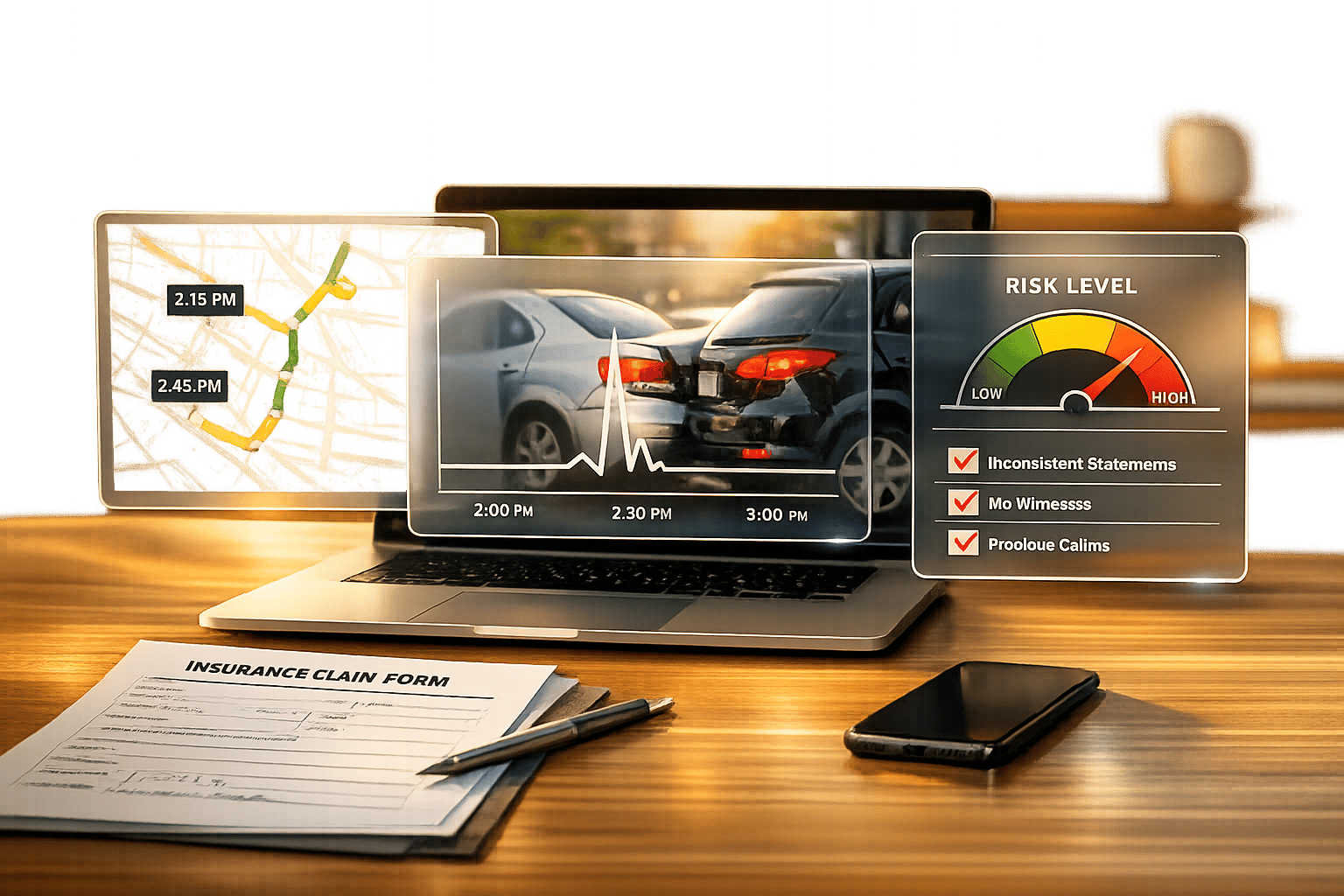
How Insurance Companies Spot False Accident Claims
Insurance companies are cracking down on fraudulent accident claims, which cost the U.S. economy billions annually. Fraudulent claims lead to higher premiums for everyone, with U.S. households paying an extra $400–$700 per year. Insurers use advanced tools and techniques to detect fraud, including analyzing claim patterns, using AI, and investigating physical evidence.
Key points:
- Red Flags: Suspicious timing, missing or inconsistent details, inflated repair or medical costs.
- Investigation Methods: Claim history reviews, private investigators, telematics data, and AI-powered fraud detection systems.
- Modern Tools: AI detects fake documents, analyzes accident descriptions, and identifies fraud networks.
- Vehicle Data: Event Data Recorders (EDRs) and GPS logs provide critical evidence to verify claims.
- Prevention: Honest and accurate reporting, along with organized evidence, ensures smoother claim processing.
Insurers aim to protect honest policyholders by identifying fraud early, reducing costs, and maintaining fair premiums.
Warning Signs of Fraudulent Claims
Unusual Timing and Claim Patterns
Timing can be a major clue when it comes to spotting fraudulent claims. For instance, claims filed immediately after a policy change often raise suspicion. Adjusters are particularly cautious with individuals who have a history of filing frequent claims that follow recognizable patterns.
Scenarios like stolen vehicles or claims that coincide with personal events - such as vacations or seasonal job changes - are especially concerning. These timing irregularities naturally prompt investigators to dig deeper into the details of the claim.
Inconsistent or Missing Information
Adjusters are trained to identify contradictions in accident reports. One red flag is when witness statements sound rehearsed or lack proper documentation. For example, if multiple passengers provide statements that are nearly identical in wording, it suggests they may have coordinated their stories. Similarly, when claimants initially downplay injuries at the scene but later report severe harm, it raises questions about the accuracy of their claims.
Other inconsistencies, such as discrepancies between telematics data and the claimant's account of events, also stand out. Missing key documents, like police reports, can further arouse suspicion. Even a claimant's behavior can be telling - someone who appears unusually calm after a significant loss might warrant closer scrutiny. These inconsistencies often lead insurers to cross-check physical evidence with the reported details.
Questionable Repair and Medical Costs
Inflated repair or medical bills are a common tactic in fraudulent claims. For example, when all vehicles involved in an accident are sent to the same repair shop - especially one located far from the claimants' homes - it raises eyebrows. Fraudulent shops may bill for new parts while using used ones or inflate repair estimates to match the policyholder's deductible, ensuring the insurer covers everything.
Medical claims can be equally suspicious. When multiple passengers report identical injuries, like whiplash or headaches - conditions that are difficult to verify with X-rays or MRIs - it often signals potential fraud. Some "accident doctors" or attorneys direct claimants to specific clinics that prescribe unnecessary, long-term treatments. In one case, individuals were convicted for steering accident victims to clinics that billed for treatments that weren’t needed.
When repair or medical costs seem excessive compared to the severity of the accident, adjusters take a closer look. For example, a minor fender-bender shouldn't result in extensive physical therapy or costly repairs for pre-existing damage. Such discrepancies often trigger advanced investigations to uncover fraudulent activity.
sbb-itb-6a9d141
Methods Insurance Companies Use to Investigate Claims

Traditional vs AI-Powered Insurance Fraud Detection Methods Comparison
Reviewing Past Claims and Behavior
Insurance companies often start investigations by digging into your claims history. They use massive databases like ISO ClaimSearch, which holds over a billion records, to spot patterns. For example, they check if someone has filed multiple claims for the same incident with different insurers or if their claim patterns resemble known fraud cases.
Adjusters also pay attention to how often and what types of claims you’ve filed. Submitting claims across different insurance types - like auto, health, and homeowners - within a short period can raise eyebrows. They may even look into your financial background to see if there’s a possible motive for fraud.
To go further, insurers use specialized teams and software to find connections between claimants, lawyers, and service providers that frequently appear in suspicious claims. When these patterns seem questionable, they escalate the investigation.
Using Investigators and Surveillance
If something seems off, insurance companies might bring in private investigators. These professionals often conduct surveillance over several days in public spaces to confirm whether a claimant’s physical abilities match their reported injuries. Take the case of a Southern California police officer in 2022, who claimed a severe concussion left her totally disabled. Investigators found she participated in 5K races, played golf, and went snowboarding during the same period - leading to charges for insurance fraud.
Digital forensics is another tool in their arsenal. Investigators comb through social media platforms like Facebook and YouTube, searching for posts that contradict claims. They even analyze photo metadata, such as timestamps and GPS locations, to confirm if events happened as reported. Beyond this, they might reconstruct accidents or interview witnesses to verify details.
One bizarre example occurred in January 2024, when four men in Los Angeles were caught faking a bear attack on luxury cars, including a Rolls Royce Ghost. Investigators, with help from the California Department of Fish and Wildlife, discovered the "bear" was actually a person in costume. A search of one suspect’s home revealed the costume used in the scam.
AI and Data Analysis Tools
Modern insurance companies are leaning heavily on artificial intelligence to process claims faster and more effectively. AI systems can scan millions of claims in real time, flagging unusual requests that deviate from normal patterns. These systems assign a "fraud risk score" based on a policyholder's history, helping investigators focus on high-risk cases before payouts are issued.
AI technology also uses tools like natural language processing and computer vision to spot inconsistencies in accident descriptions or detect fake images. For instance, manipulated photos of vehicle damage or AI-generated accident images can be flagged by these systems.
"These tiny visual mismatches [in AI images] are often the first red flags of an AI-generated claim"
– Adam Hall, Insurance Fraud Specialist at SAS
Graph analytics takes it a step further, uncovering hidden connections between claimants, medical providers, attorneys, and repair shops across different states. This helps insurance companies identify large fraud networks.
"Identity theft and the use of synthetic identities are the foundation for life insurance, medical-related fraud, and cargo theft"
– David J. Glawe, President and CEO of the National Insurance Crime Bureau (NICB)
AI systems can even detect synthetic identities - fake profiles created using real Social Security numbers combined with fabricated names - which caused over $47 billion in losses in 2024.
| Feature | Traditional Methods | AI & Data Analysis Tools |
|---|---|---|
| Speed | Manual reviews take weeks or months | Real-time analysis of millions of claims |
| Pattern Recognition | Relies on human memory and static checklists | Machine learning finds subtle anomalies |
| Document Verification | Physical inspections | Detects deepfakes and verifies metadata |
| Scope | Limited to individual claims | Identifies fraud rings across states |
| Data Source | Interviews and paper files | Uses telematics, IoT sensors, and digital data |
The focus in the industry has shifted from recovering losses after fraud to preventing it in real time. AI systems now cross-check claims with data from vehicle GPS, speed sensors, and impact monitors, catching inconsistencies before payouts are made. This proactive approach not only saves money but also protects honest consumers by stopping fraud early. For more information on navigating the claims process, see our car accident guides.
Physical Evidence: Vehicle and Accident Scene Inspections
Vehicle Data and Telematics
Modern vehicles are like digital detectives, recording critical data during every trip and collision. Event Data Recorders (EDRs), often referred to as "black boxes", capture essential details in the moments leading up to an accident. These include vehicle speed, brake and accelerator use, steering input, and whether seatbelts were fastened. This information can be a game-changer, especially when a claimant's account doesn't align with the physical evidence.
"The retrieved electronic data will typically tell us how the vehicle was operated leading up to a collision including accelerator and brake pedal application, steering input, vehicle speed, and seatbelt use."
– Richard Robertson, Senior Engineer at J.S. Held
GPS tracklogs add another layer of insight, creating a "breadcrumb trail" of a vehicle's movements for days or even months before a claim. This technology has been instrumental in uncovering fraudulent claims. Take, for instance, a 2024 BindRight investigation where a luxury car owner claimed his vehicle was stolen and later found burned in a remote area. Telematics data revealed he had driven the car to the site late at night, contradicting his story. A forensic analysis of the fire confirmed it had been intentionally set.
EDRs, however, only record data when the vehicle is powered on. This detail can expose false claims, such as when someone reports a "hit and run" involving a parked car. If the EDR shows a recorded event, it proves the vehicle was running at the time, invalidating the claim. Physical evidence, like rotational scratches, often corroborates these findings. Moreover, some newer vehicles, like those from Toyota and General Motors, include built-in cameras that snap images when safety systems activate, providing visual proof of collisions.
Examining Vehicle Damage
While digital data offers precision, physical inspections of vehicle damage provide undeniable, tangible evidence. Together, these methods form a powerful approach to uncovering fraud. Forensic engineers scrutinize every dent, scratch, and paint mark to determine if they match the reported accident. They assess the height, direction, depth, and profile of contact marks to see if they align with the described collision.
Paint transfer analysis is especially telling. Automotive paint is typically protected by a clear coat, which limits transfer between vehicles. On the other hand, stationary objects like concrete barriers or parking poles lack this coating, leaving behind significant paint deposits when struck.
"Excessive paint transfer observed on vehicles is often a strong sign that the vehicle contacted a painted stationary object."
– Shady Attalla and Liam Rodgers, Forensic Engineering Specialists at J.S. Held
Laboratory tests can confirm whether paint samples come from another vehicle or a stationary object. Investigators also look for signs of "enhanced damage", where claimants exaggerate or add damage to a legitimate claim. They examine whether all damage aligns with a single event or suggests multiple, unrelated incidents.
In one notable 2024 case, Roadway Dynamics investigated a delivery van that rear-ended a sedan, leading to $750,000 in personal injury claims. The van's EDR revealed the driver had braked 1.2 seconds before impact. Dashcam footage later showed a second car had deliberately cut off the sedan, causing the collision. Using trajectory modeling, the insurance company denied the claims. Additionally, Diagnostic Trouble Codes (DTCs) can uncover pre-existing mechanical issues, offering further evidence in cases of suspected fraud.
How to File an Accurate Claim
Provide Complete and Truthful Information
Honesty is your best tool when filing an insurance claim. Most auto insurance policies come with a "notification and cooperation" clause, which means you’re required to report accidents promptly and provide accurate information throughout the process. Failing to do so can lead to serious consequences, like your insurer refusing to defend you in a lawsuit. If you’re unsure about any details, it’s better to admit uncertainty rather than guess. Adjusters often spot inconsistencies between your statement and physical evidence - such as damage patterns or telematics data - which can raise red flags and result in a denied claim.
Fraudulent claims don’t just hurt you; they increase costs for everyone. That’s why accurate reporting is so important. For starters, call 911 right after an accident. This creates an official record that makes it harder for the other driver to alter their story later. Be upfront about any pre-existing injuries or medical conditions, as insurers will cross-check your details against police reports, witness accounts, and telematics data. A well-documented and truthful claim not only speeds up the process but also avoids triggering fraud concerns.
Once your statement is complete, focus on gathering evidence to back up your account.
Collect and Organize Evidence
Start by taking clear, wide-angle photos of the accident scene. Include details like vehicle positions, damage, license plates, traffic signals, and debris. These images will help adjusters visualize what happened and support your claim.
Look for neutral witnesses, such as pedestrians or uninvolved drivers, and get their contact information. Adjusters place more trust in third-party accounts than in statements from those directly involved in the crash. If possible, record any "excited utterances" - for example, the other driver saying, "I didn’t see you" - as these spontaneous remarks are often admissible in court.
Keep a detailed journal to document how the accident has affected you physically and financially. Note symptoms like headaches or trouble sleeping, as well as financial impacts like missed workdays. This information can support claims for pain and suffering. For lost wages, gather documents like tax returns, pay stubs, and employer verification letters. Additionally, maintain a log of your communications with the insurance company, noting dates, representatives’ names, and the details of your conversations.
Once you’ve collected all your evidence, you might want to seek professional help to guide you through the claims process.
Get Professional Help with Your Claim
Dealing with serious injuries, disputes over liability, or delays from your insurer can make the claims process overwhelming.
That’s where Collision Help | Nationwide Accident Help (https://collisionhelp.org) can step in. They offer free evaluations to help you document and file your claim correctly. You can upload photos of your vehicle damage through their secure platform and receive expert feedback within 24 hours. By using their service, you ensure your claim includes all the necessary evidence and avoids common mistakes that could delay or jeopardize your compensation. It’s a smart way to get the fair settlement you deserve without unnecessary hassle.
Conclusion: Protecting Honest Claimants Through Proper Verification
Insurance fraud increases premiums by an estimated $400 to $700 annually for policyholders who follow the rules, highlighting the importance of thorough claim verification to maintain fair rates. With about 15% of auto insurance premiums going toward undetected fraud, identifying and addressing these false claims ensures that honest drivers aren't unfairly burdened.
Modern fraud detection tools do more than just identify scams - they also streamline the insurance claim filing process for those filing legitimate requests. AI-powered systems, for example, can reduce false positives by up to 30%, allowing honest claimants to receive their payouts more quickly.
Comprehensive investigations also shield innocent drivers from the repercussions of staged accidents or "cash for crash" schemes. These measures help ensure that responsible policyholders aren't caught in the crossfire of fraudulent activities.
FAQs
Can my insurer use my car’s black box or GPS data to challenge my claim?
Yes, your insurance company can access data from your car’s black box or GPS to investigate claims. These devices capture information like your speed, braking patterns, steering inputs, impact force, and location. Insurers may analyze this data to verify the details of an accident or to dispute your account of events. It’s important to ensure the details you report align with this recorded data to prevent potential issues.
What documents and photos should I gather to avoid fraud flags?
When filing an insurance claim, it's crucial to present clear and accurate evidence to avoid raising any red flags. Here are some steps you can take to ensure your claim process goes smoothly:
- Take Clear, Timestamped Photos: Capture multiple angles of your vehicle's damage and the accident scene. These photos should clearly show the extent of the damage and help establish the timeline of events.
- Gather Supporting Documents: Include important paperwork such as police reports, repair estimates, medical records (if injuries are involved), and receipts for any related expenses. These documents add credibility to your claim.
- Keep Detailed Records: Maintain a log of all communications with your insurance provider, repair shops, and any other parties involved. This includes emails, phone call summaries, and any additional evidence that supports your case.
By being thorough and organized, you can help substantiate your claim and reduce the chances of it being flagged for further investigation.
When should I get help from Collision Help | Nationwide Accident Help?
If you’re dealing with insurance claims, vehicle repairs, or disputes after an accident, Collision Help | Nationwide Accident Help is a resource worth turning to. Their expertise can assist in ensuring your information is correct and that the entire process moves along without unnecessary complications.