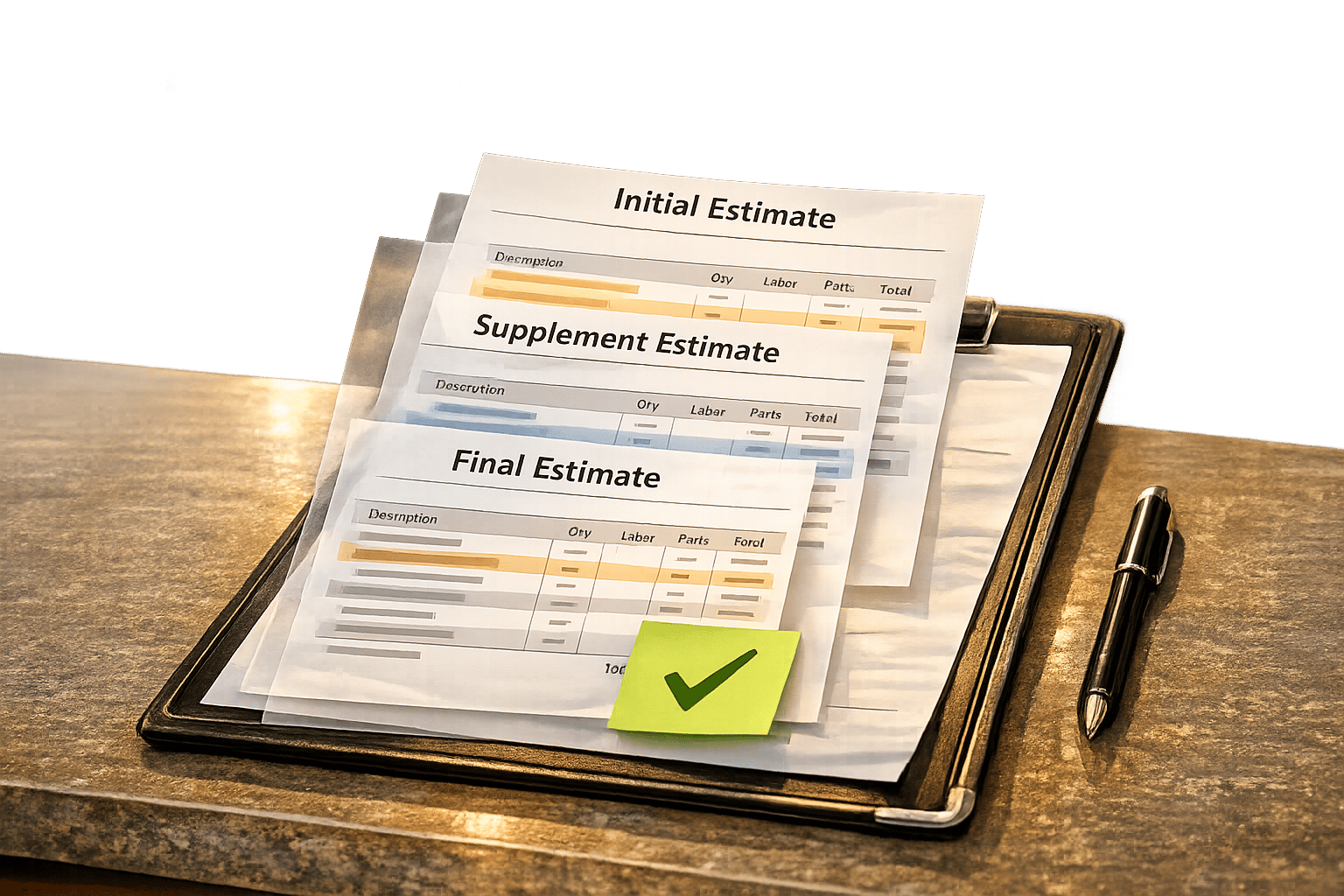
Understanding Supplemental Repair Estimates
When your car is in for repairs, the initial estimate only covers visible damage. But once work begins, hidden issues often surface, requiring a supplemental repair estimate. This updated quote accounts for additional repairs discovered during the process, such as structural damage, wiring problems, or recalibrations for modern safety systems.
Here’s what you need to know:
- What it is: A revised repair estimate for damage not initially identified.
- Why it happens: Hidden problems found during teardown or changes in parts/methods.
- How it works: Repair shops document the new damage, submit it to your insurer, and await approval before proceeding.
- Impact on costs: Your out-of-pocket expense usually stays the same (just your deductible), but insurers may declare a total loss if repair costs exceed the car's value.
Clear communication with your repair shop and insurer helps avoid delays. Always review detailed breakdowns of charges and ensure all repairs are properly documented for your safety and peace of mind.
CONSUMER TIP: What is a supplement? And why does it cost more?
Why Supplemental Estimates Happen
Supplemental estimates are a common part of collision repair. They usually occur due to two main reasons: hidden damage revealed during the repair process and adjustments to parts or repair methods once the work is underway. Let’s break these down, starting with hidden damage.
Hidden Damage Discovered During Repairs
Initial repair estimates are often based on visible damage. As Elite Automotive Finishes explains:
"Insurance companies often write estimates based on photos... These are meant to get the claim started quickly, not provide a full picture of the damage."
Once the repair process begins, technicians often uncover damage that wasn’t visible during the initial inspection. For example, removing bumpers, panels, or trim pieces can reveal issues like cracked engine mounts, damaged wiring harnesses, bent inner frames, or broken brackets. In some cases, removing panels exposes rust or corrosion that necessitates complete part replacement.
Modern vehicles introduce even more challenges. The force of a collision can impact components far from the point of impact, such as steering systems or suspension parts. Additionally, many newer vehicles require specialized recalibrations that may not be apparent during the initial estimate.
Changes in Parts or Repair Methods
Supplemental estimates don’t always stem from hidden damage. Sometimes, they’re needed because the repair approach changes. For instance, a panel initially deemed repairable might turn out to be too damaged to fix and require replacement instead. Manufacturer guidelines may also introduce unexpected safety requirements, like replacing single-use bolts or using specific welding techniques, which weren’t accounted for in the original estimate.
Parts availability and pricing can also lead to adjustments. Insurance software might list outdated prices, or an aftermarket part specified in the initial estimate might not fit properly, requiring a switch to OEM parts. Even minor administrative errors, such as incorrect paint codes or tax rates, are corrected through supplements. For example, a front-end collision estimate could increase by $1,500 or more after discovering hidden damage like a leaking AC condenser or cracked radiator support.
These scenarios illustrate why supplemental estimates are a regular part of modern collision repair. They ensure that repairs address all issues, restoring vehicles to their proper condition.
How the Supplemental Estimate Process Works
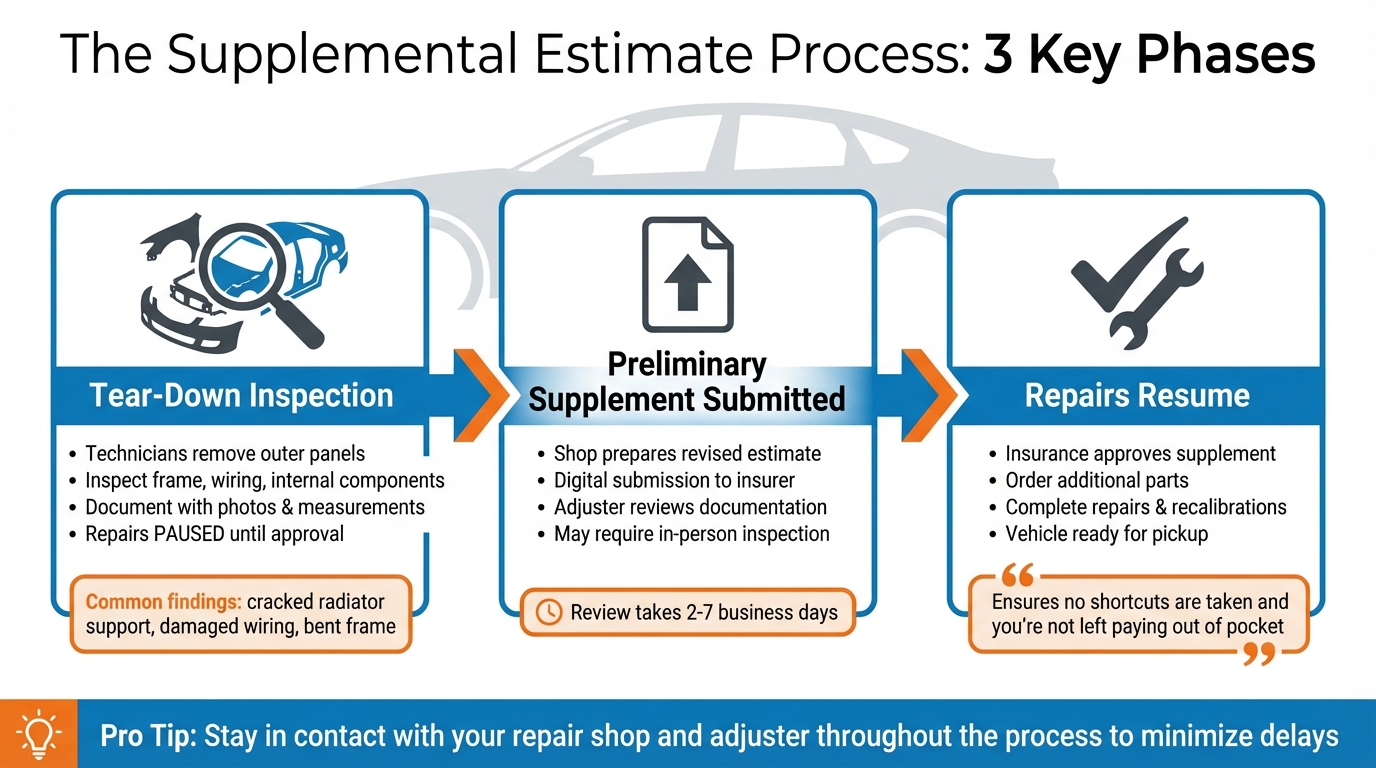
How the Supplemental Repair Estimate Process Works: 3-Step Guide
Knowing how supplemental estimates work can prepare you for what happens when your repair shop uncovers additional damage. The process generally involves three key phases: documenting the damage, submitting a revised estimate, and getting approval from your insurance company. Each step ensures that all repairs are properly authorized before moving forward. This process ensures that any hidden damage, as discussed earlier, is fully addressed. Detailed documentation plays a crucial role in securing supplement approval.
Finding and Recording New Damage
Hidden damage often comes to light during the tear-down phase, when technicians remove outer panels to inspect the vehicle's internal components, such as the frame or wiring. For example, they might find issues like a cracked radiator support or damaged wiring. When this happens, the repair shop documents the findings with photos, measurements, and detailed notes. This documentation helps demonstrate to the insurance company why the additional repairs are necessary.
At this stage, the repair shop takes responsibility for identifying and recording all new damage. Repairs are usually paused until the insurance company reviews and approves the updated findings.
Submitting to the Insurance Company
Once the additional damage is documented, the repair shop prepares a revised estimate - often called a Preliminary Supplement - and submits it to your insurance provider. Many shops use digital platforms to send this information directly to adjusters, which can speed up the review process.
An insurance adjuster then reviews the supplement. Depending on the extent of the damage and the associated costs, the insurer might request an in-person inspection, a video call, or a review of the submitted digital documentation. This review typically takes 2 to 7 business days, but timelines can vary based on the insurer's workload and how complex the damage is. After approval, the process moves forward to the final repair steps.
Getting Approval and Completing Repairs
Once the insurance company gives the green light, repairs resume. Technicians proceed with the necessary work, including ordering supplemental parts and recalibrating systems if needed - such as Advanced Driver Assistance Systems (ADAS) in newer vehicles. As Solon Collision explains:
A supplement may temporarily pause repairs while approval is granted, but it ensures no shortcuts are taken - and that you're not left paying for overlooked repairs out of pocket.
When all repairs are finished, the shop contacts you to arrange for vehicle pickup. At this point, your car should be fully restored and ready to go.
sbb-itb-6a9d141
How Supplemental Estimates Affect Costs and Coverage
Impact on Your Total Repair Bill
Supplemental estimates can increase your repair bill significantly. For instance, an initial estimate of $2,000 might climb to $3,500 once hidden damage is uncovered. In cases of hail damage, the initial $2,000 estimate often grows by $1,000 or more after all dents are fully assessed.
If you're filing an insurance claim, your out-of-pocket expenses typically remain unchanged - you’re only responsible for your deductible. As Sydney Kofron explains:
When a collision repair... is submitted, it's an internal adjustment between us and the insurance company. It doesn't mean your out-of-pocket cost is going up.
However, if the total repair costs exceed your vehicle's value, the insurer might declare it a total loss. This often happens when teardown reveals hidden structural or frame damage.
How Insurance Covers Supplemental Costs
Once you understand how supplemental estimates affect costs, it’s essential to know how insurance handles these adjustments.
Insurance companies usually cover supplemental costs as long as the additional repairs are directly tied to your claim and fall within your policy limits. Once approved, insurers typically pay the repair shop directly, often within 2 to 7 business days.
To secure approval, repair shops need to provide detailed documentation, including photos, measurements, and itemized notes, to prove the damage is from the accident. For larger supplements, insurers may require a second in-person inspection by an adjuster before giving the green light. If you're paying out-of-pocket, the repair shop must get your approval before starting any additional work.
Tips for Managing Supplemental Estimates
Stay in Contact with Your Repair Shop and Adjuster
Keeping in touch with your repair shop and adjuster is crucial to avoiding unnecessary delays. Start by agreeing on your preferred way to communicate and confirm contact details right from the beginning. Supplemental estimates often come into play during the teardown phase - when your vehicle is taken apart and hidden damage is revealed. Sometimes, repair shops may even invite adjusters to inspect the damage in person to speed up the approval process.
It’s also helpful to maintain a communication log. Record names, dates, times, and the topics discussed. This way, you can track progress and follow up if approvals seem to be dragging. As Collision Consultants of North America explains:
Effective communication throughout the auto insurance supplement process is key to minimizing delays and ensuring that all parties - especially you as the vehicle owner - are kept informed.
This approach ensures everyone stays on the same page and helps you get a clear, itemized breakdown of all charges.
Ask for Detailed Breakdowns
Once communication is flowing, make sure you get a detailed explanation of all charges. Request a line-by-line breakdown of every cost. If terms like "Overhaul" (O/H), "Overlap", or "Refinish" appear, ask your repair shop to explain what they mean so you know exactly what’s being repaired or replaced. It’s also important that the estimate specifies part numbers and makes it clear whether parts are New OEM, Aftermarket, or Recycled. Don’t forget to ask about additional costs like ADAS sensor calibrations, 4-wheel alignments, or specialized electronic scans. United Policyholders highlights an important point:
If the item is not listed in the estimate, the cost for it will not be in the final estimate total.
This level of detail ensures you’re not caught off guard by missing or unclear charges.
Use Photo Documentation Tools
Submitting clear photos can help speed up the approval process. Take well-lit photos of the damage, clean the area beforehand, and capture the damage from the recommended angles. Adding short notes to highlight hidden damage can also be helpful. Collision Consultants of North America stresses the importance of this step:
such thorough documentation is vital as it substantiates the necessity of the additional repairs and helps expedite the approval process.
For personalized advice, you can upload photos of your vehicle damage to Collision Help | Nationwide Accident Help and get feedback within 24 hours. This extra effort can save you time and ensure a smoother process.
Conclusion
Supplemental repair estimates play a crucial role in collision repair - over 90% of claims involve them due to the increasing complexity of modern vehicles. These estimates address hidden damage, such as cracked frames, damaged wiring, or malfunctioning ADAS sensors, that often only becomes evident after a vehicle is disassembled.
By documenting and addressing these issues, supplements ensure your vehicle is fully restored to its pre-accident condition without unexpected costs. As Solon Collision explains:
A supplement may temporarily pause repairs while approval is granted, but it ensures no shortcuts are taken - and that you're not left paying for overlooked repairs out of pocket.
This process highlights why it’s important to understand how supplements work. A thorough teardown inspection often uncovers additional repairs, keeping you informed and helping to avoid unnecessary stress.
FAQs
What can I do if my insurance company denies a supplemental repair estimate?
If your insurance company rejects a supplemental repair estimate, the first step is to ask for a clear explanation of the denial. Common reasons might include claims that the damage was pre-existing or that the documentation provided wasn’t enough to justify the additional repairs. To counter this, compile strong evidence - this could include detailed photos of the damage, repair shop assessments, and any other relevant materials that support your case.
If the denial persists, you have the option to dispute the decision. This may involve submitting more comprehensive documentation or requesting a formal review of your claim. Bringing in a professional appraiser or claims adjuster can also add weight to your argument. In more challenging situations, you might need to contact your state’s insurance department or consider mediation as a resolution path. Familiarizing yourself with your rights and the rules specific to your state can simplify this often frustrating process. For further assistance, organizations like Collision Help | Nationwide Accident Help specialize in guiding claim disputes and repair estimate challenges.
What can I do to avoid delays in the supplemental estimate process for my car repairs?
To keep the supplemental estimate process moving smoothly, it's important to have your repair shop conduct a detailed inspection of your vehicle as early as possible. This helps uncover any hidden damages upfront. Providing clear documentation, like photos and detailed notes, can also make it easier to get approval for extra repairs.
Stay in regular contact with both your repair shop and your insurance company. Quick approval of supplemental estimates as soon as they're submitted can help avoid unnecessary delays. By focusing on thorough documentation, consistent communication, and planning ahead, you can help ensure your repairs stay on schedule.
How can I avoid the need for a supplemental repair estimate?
To lower the chances of needing a supplemental repair estimate, begin with a careful and detailed initial inspection of your vehicle's damage. Make sure to document all visible problems, covering structural, mechanical, and electrical components. Taking clear and well-lit photos of the damage can help ensure nothing is overlooked.
Another important step is conducting a thorough disassembly and damage analysis before submitting the first estimate. This process can reveal hidden issues, such as internal frame damage or concealed mechanical problems, that might not be immediately apparent. Catching these early can save time and avoid surprises during the repair process.
Lastly, working with skilled technicians and adhering to standardized damage assessment procedures can reduce the risk of missing critical details during the initial evaluation. This proactive strategy helps streamline repairs, cuts down on delays, and minimizes unexpected costs for vehicle owners.