How Fault Is Determined in Multi-Vehicle Accidents
Determining fault in multi-vehicle accidents can be complex, but it’s critical because fault directly impacts financial liability, insurance claims, and compensation. Here’s what you need to know:
- Fault Matters: The driver primarily responsible - or their insurer - pays for damages. In states like Texas, being over 51% at fault means no compensation.
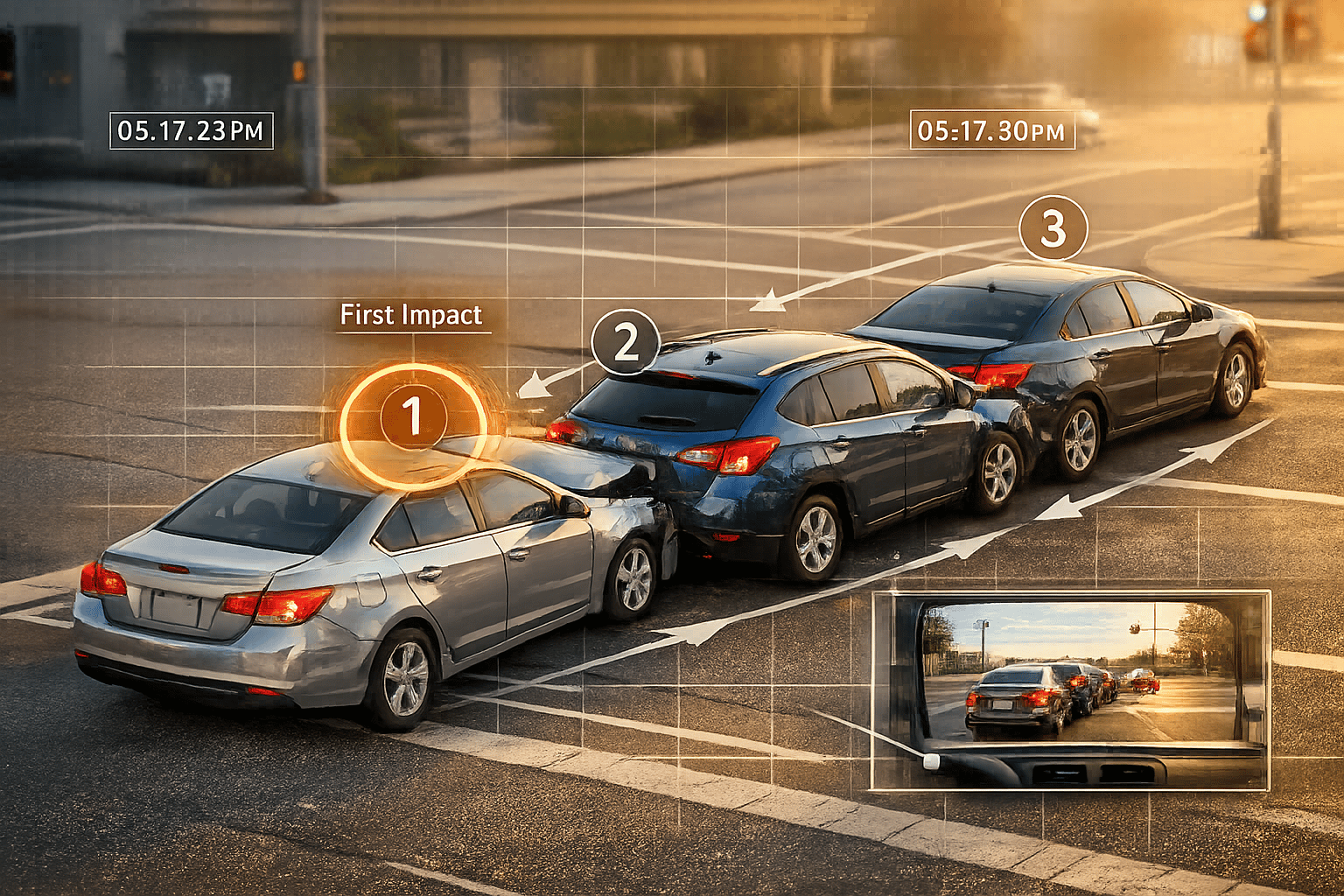
- Challenges in Multi-Vehicle Crashes: These involve multiple drivers, insurers, and often conflicting accounts. Chain-reaction accidents require investigators to pinpoint the "first point of contact."
- Key Factors: Fault is determined by vehicle positions, traffic violations (e.g., speeding, tailgating), proximate cause, negligence, and environmental conditions like weather or poor roads.
- Evidence: Photos, witness statements, dashcam footage, and accident reconstruction are vital for establishing fault.
- State Laws Vary: States follow different negligence rules - some bar recovery if you’re even slightly at fault, while others allow partial compensation based on your fault percentage.
Fault assignment can be disputed by reviewing police reports, gathering new evidence, or hiring experts. Understanding these factors ensures you’re better prepared to navigate claims and disputes.
Factors Used to Determine Fault
Vehicle Position and Traffic Violations
When investigators analyze a crash, they pay close attention to the final resting positions of vehicles, skid marks, and debris patterns. These details help them reconstruct the sequence of events. The driver responsible for the "first point of contact" - the initial collision that sets off a chain reaction - often bears the majority of the blame for a pileup.
Certain traffic violations make fault easier to determine. For instance, rear-end collisions typically place blame on the striking driver, while head-on crashes caused by crossing into another lane or intersection accidents often clearly indicate fault. Between 2005 and 2021, there were over 130 fatal crashes in the U.S. involving 10 or more vehicles, highlighting the importance of accurate vehicle position analysis.
Violations like speeding (a factor in 26% of fatalities), tailgating, running red lights, or distracted driving (linked to 8–9% of fatalities) serve as concrete evidence of negligence. For example, if tailgating causes a vehicle to be pushed into another car, the tailgating driver may share some of the blame, even if they didn’t initiate the crash. Beyond the physical evidence, identifying the initial negligent action is crucial for determining liability.
Proximate Cause and Negligence
Proximate cause focuses on the original negligent act - such as tailgating or driving too fast for conditions - that set off the chain of events. Investigators trace back through each collision to identify this starting point, even when crashes happen in quick succession.
"Negligence is defined as failure to exercise the duty of care that a reasonable person would under typical circumstances." - Block O'Toole & Murphy
Determining negligence involves evaluating whether each driver acted reasonably. For instance, a driver with broken brake lights could share fault if rear-ended, as faulty equipment breaches the duty of care. Similarly, distracted driving, such as texting, or DUI are clear examples of negligence. Alcohol impairment, for instance, is involved in about 30% of all fatal car crashes. When multiple drivers contribute to a crash, investigators assign fault percentages based on how much each party’s actions played a role.
Weather and Road Conditions
Environmental factors like rain, ice, or fog don’t excuse drivers from responsibility. Instead, they redefine what is considered reasonable behavior. Drivers are expected to adjust their speed and maintain greater following distances in poor weather. For example, failing to slow down during heavy fog or not increasing stopping distance on wet roads is considered a breach of duty, even if the driver wasn’t exceeding the speed limit.
Rain alone accounts for nearly 50% of all weather-related traffic accidents, according to the National Highway Traffic Safety Administration. Investigators often examine skid marks alongside pavement friction to understand how road conditions influenced the crash. In ideal weather, a 2–3 second gap between vehicles is safe, but this distance should be doubled or tripled in hazardous conditions. In pileups caused by bad weather, fault may be shared when multiple drivers fail to adjust appropriately.
"When a car accident was caused, at least in part, by adverse weather, it may impact how much fault drivers are liable for." - Arthur Law Firm
Poor road conditions, such as construction zones, inadequate maintenance, or malfunctioning traffic signals, can shift some liability away from drivers. If investigators find that dangerous road design or insufficient signage contributed to the crash, responsibility may extend to government agencies or contractors managing the roadway.
sbb-itb-6a9d141
How does an insurance company determine fault in a massive pileup?
Evidence Needed to Determine Fault
To establish fault in an accident, gathering solid evidence is a must.
Photos and Physical Evidence
Documenting the crash scene thoroughly is a key step. Take photos of all vehicles involved, covering multiple angles. Include both wide shots and close-ups to highlight specific damage. The location and nature of the damage can reveal whether a vehicle was rear-ended, sideswiped, or hit head-on. This damage assessment is also a critical factor in how insurance calculates total loss for the vehicles involved.
Don’t overlook the surrounding area - photograph skid marks, tire tracks, and scattered debris. These details help investigators piece together the collision sequence and timing. As McCormick & Murphy, P.C. explains, "Physical evidence on the roadway illustrates how the accident unfolded. Skid marks indicate braking patterns, while debris distribution shows impact points and vehicle trajectories".
Capture other factors that could have played a role, like weather conditions, road hazards, and the visibility of traffic signs or signals. Additionally, photograph license plates, insurance cards, and any dashboard cameras or nearby security and traffic cameras that might have recorded the incident. Digital footage from these sources can be incredibly useful later.
Witness Statements and Dashboard Camera Footage
Eyewitness accounts provide an unbiased view of the events, offering details on vehicle speeds, driver actions, and other factors that cameras may not capture. Be sure to collect names and contact information from neutral bystanders.
Dashboard cameras, on the other hand, provide an objective and continuous record. They can show right-of-way disputes at intersections, illegal lane changes, tailgating, or even pinpoint the driver responsible for a chain reaction. If you have dash cam footage, save it immediately to avoid automatic overwriting. Preserve several minutes of footage before and after the crash to provide context, including traffic conditions and driver behavior leading up to the collision. Importantly, do not edit or alter the footage, as this could render it inadmissible in court.
When physical evidence and testimony leave gaps, more advanced methods may be required.
Accident Reconstruction Analysis
In cases where on-site evidence and witness statements don’t provide a complete picture, accident reconstruction experts step in to analyze the details. Using principles of physics and engineering, they determine vehicle speeds from damage patterns, calculate impact angles, and recreate the sequence of events in complex crashes.
Modern vehicles equipped with Event Data Recorders (EDRs) offer additional insights. These devices log critical data, such as pre-crash speed, braking, and steering inputs. Starting in December 2024, federal regulations will require EDRs to record 20 seconds of pre-crash data at a higher resolution, giving reconstructionists even more precise information to validate or challenge witness accounts. Tools like 3D laser scanning and drones also allow experts to create detailed digital models of accident scenes before evidence fades.
Hiring a reconstruction expert early is essential since skid marks, debris, and other physical evidence can disappear quickly after a crash. These professionals often hold specialized credentials, such as ACTAR accreditation, and their testimony carries significant weight with both insurance companies and courts.
How Insurance Companies and State Laws Affect Fault
State Negligence Laws and Fault Recovery Rules Comparison
Once all evidence is collected, insurance adjusters assign fault percentages based on their evaluations and the negligence laws of the state where the accident occurred.
How Insurance Adjusters Assign Fault Percentages
Fault determination involves a detailed four-part negligence analysis. Adjusters look at:
- Duty: The legal responsibility to follow traffic laws and ensure safety.
- Breach of Duty: Whether a driver failed to meet these obligations.
- Causation: If that failure directly caused the accident.
- Damages: The resulting injuries or property damage.
To make these decisions, adjusters review a range of evidence, including police reports, witness accounts, photos of the accident scene, dashcam footage, black box (EDR) data, and even cell phone records.
"Insurance companies, not police officers, determine who was responsible in an auto incident."
For multi-vehicle accidents, adjusters take additional steps. They analyze the sequence of events to establish a timeline, evaluate which factors played a significant role in causing the crash, and assess whether the outcome could have been reasonably anticipated. When multiple insurance companies are involved, they negotiate fault percentages. If they can’t agree, the matter goes to arbitration for resolution.
State negligence laws then determine how fault percentages impact compensation.
Comparative Negligence Laws by State
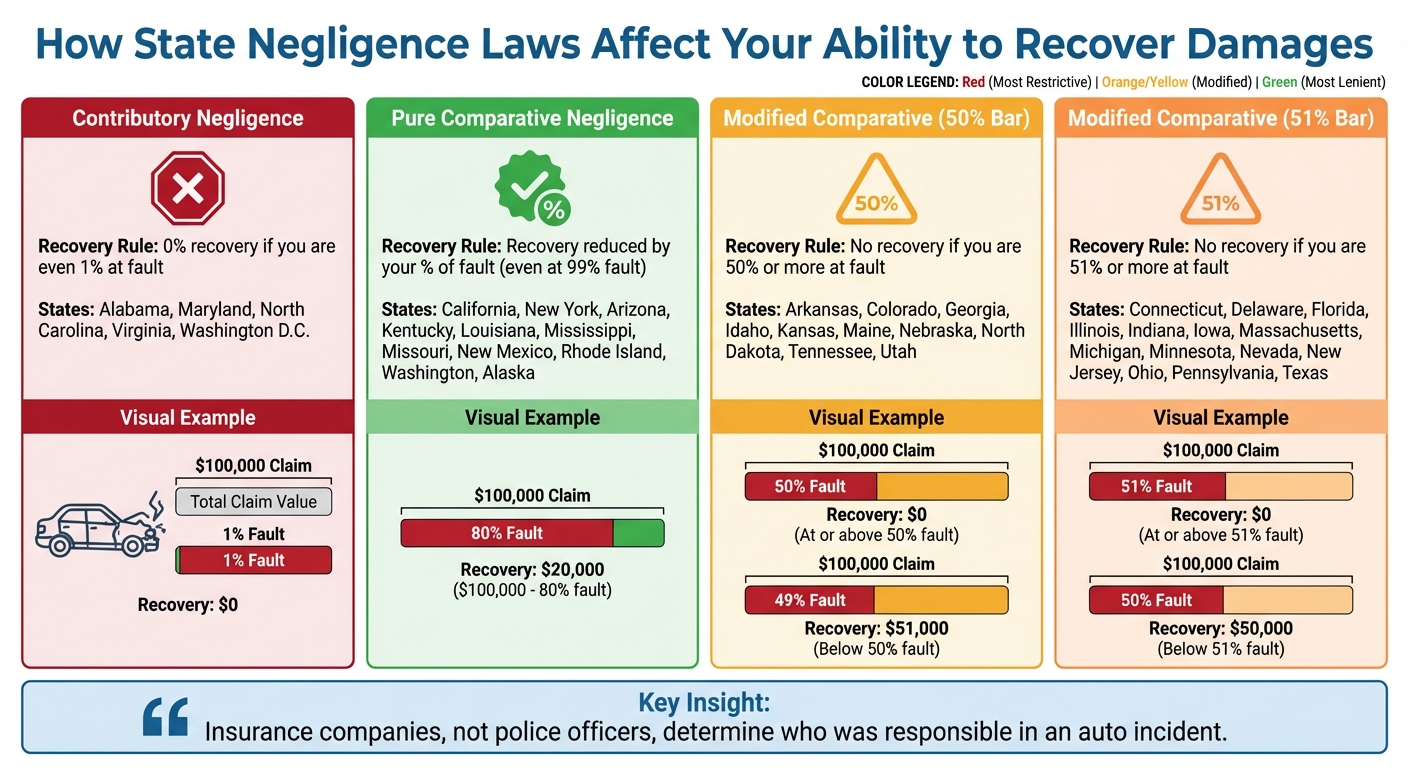
After fault percentages are assigned, state laws decide how these percentages affect the ability to recover damages. The rules vary widely. For more information on navigating the claims process, see our car accident guides.
Contributory Negligence: In five jurisdictions - Alabama, Maryland, North Carolina, Virginia, and Washington D.C. - even 1% fault means you can’t recover any damages.
"With a contributory negligence rule in place, these states prohibit drivers in an accident from recovering any compensation for their damages if they've been found to have contributed to the accident in any way."
- Laura Longero, Editor-in-Chief at CarInsurance.com
Pure Comparative Negligence: Some states allow recovery regardless of how much fault you bear. For instance, if you’re 99% at fault, you can still recover 1% of your damages. For example, in a $100,000 claim where you’re 80% responsible, you’d receive $20,000.
Modified Comparative Negligence: The majority of states follow this system, which sets a fault threshold.
- 50% Bar States: You can recover damages only if your fault is less than 50%.
- 51% Bar States: You lose the right to recover damages if your fault exceeds 50%.
For example, Florida's law states that if you're 51% at fault in an accident, you can’t recover anything. However, if you’re exactly 50% at fault, you can recover half of your damages.
In multi-vehicle accidents, the distribution of fault can complicate recovery. For instance, if fault is divided as 60%, 20%, and 20%, a driver with 60% fault would be barred from recovery in a 51% bar state. Meanwhile, the two drivers with 20% fault each could recover 80% of their damages from the other parties.
| Negligence System | Recovery Rule | Example States |
|---|---|---|
| Contributory Negligence | 0% recovery if you are even 1% at fault | AL, MD, NC, VA, D.C. |
| Pure Comparative | Recovery reduced by your % of fault (even at 99% fault) | CA, NY, AZ, KY, LA, MS, MO, NM, RI, WA, AK |
| Modified Comparative (50% Bar) | No recovery if you are 50% or more at fault | AR, CO, GA, ID, KS, ME, NE, ND, TN, UT |
| Modified Comparative (51% Bar) | No recovery if you are 51% or more at fault | CT, DE, FL, IL, IN, IA, MA, MI, MN, NV, NJ, OH, PA, TX |
How to Dispute a Fault Assignment
Getting fault determination right is crucial, especially when it impacts fair compensation. If you believe an error has been made, disputing the assignment can help correct the situation. This involves carefully reviewing official records, gathering new evidence, and sometimes seeking professional assistance.
Review Police Reports and Insurance Decisions
The first step is to check the police report for errors. Simple factual mistakes, like wrong vehicle details, dates, or insurance information, can often be fixed by submitting supporting documents such as your driver's license or vehicle registration.
However, subjective errors - like an officer's opinion on whether you were speeding or failed to yield - are much tougher to challenge. While these opinions are unlikely to be removed, you can request that your statement of events be added as a supplemental report.
"Factual errors are the easiest to correct"
- David Goguen, J.D., Nolo
It's also important to remember that police reports, while influential, aren't the final authority.
"Police reports – While influential, they are not final or legally binding"
Insurance companies conduct their own investigations and may reach different conclusions, especially if you provide new evidence. If you received a traffic citation connected to the accident, contesting it in court could also strengthen your case. Successfully challenging a citation can significantly impact the insurance fault determination. When discrepancies persist despite your efforts, expert analysis may become necessary.
Get Expert Testimony and Legal Help
If the insurance company remains firm on its decision, consider hiring an accident reconstruction specialist. These experts use scientific methods, such as analyzing skid marks, impact forces, and creating computer simulations, to piece together an accurate picture of the crash. Their findings can challenge flawed fault assessments.
Personal injury attorneys can also help by obtaining additional evidence, such as cell phone records or vehicle maintenance logs, to support the expert's analysis. This is especially important in multi-vehicle accidents where the division of fault percentages can directly affect compensation.
Get Help from Collision Help
If handling everything on your own feels overwhelming, services like Collision Help can make the process easier. They offer expert guidance on disputing fault assignments and navigating complicated insurance claims, particularly in multi-vehicle accidents. By uploading photos of your vehicle damage to their secure platform, you can receive personalized advice within 24 hours.
Collision Help’s nationwide network can assist with gathering evidence, requesting insurance reassessments, and connecting you with car accident lawyers who work on contingency - meaning no upfront fees. They start with a free evaluation to outline your options and provide a clear plan for moving forward.
Conclusion
Determining fault in multi-vehicle accidents often hinges on identifying the initial collision and evaluating whether other drivers acted negligently - like tailgating or driving while distracted. Investigators rely on factors such as vehicle placement, damage patterns, and traffic violations to determine whether drivers failed to meet their responsibilities, such as by speeding, texting, or not adapting to poor road conditions. With around 6.75 million car accidents happening annually in the U.S., multi-vehicle crashes stand out for their complexity due to shared fault.
To build a strong claim, solid evidence is a must. This includes photos, witness accounts, dashcam videos, and accident reconstruction reports, which help clarify conflicting stories. Such evidence becomes even more crucial when insurance adjusters - representing various companies - debate fault percentages to minimize payouts.
The way fault is assigned directly affects your compensation, as state laws vary widely. In contributory negligence states like Virginia, even being 1% at fault can prevent you from recovering damages. In pure comparative negligence states like California, your compensation is reduced by your percentage of fault. Meanwhile, in modified comparative negligence states like Georgia and Texas, you may only recover damages if your fault is below a certain threshold, typically 50%–51%. Because of these differences, disputing fault assignments often requires professional assistance.
If you feel fault has been unfairly assigned or your settlement offer is inadequate, seeking expert help can make all the difference. Collision Help | Nationwide Accident Help provides expert guidance to help you navigate these disputes. By securely uploading photos of vehicle damage, you can receive personalized advice within 24 hours. Their nationwide network connects you with accident lawyers on a contingency basis and assists in gathering evidence to challenge inaccurate fault determinations - all starting with a free evaluation.
FAQs
Who decides fault in a multi-car crash - police or insurance?
Fault in a multi-vehicle crash is usually decided by a combination of police officers and insurance adjusters. Police officers examine the crash scene, noting vehicle positions and gathering evidence. Meanwhile, insurance adjusters rely on police reports, driver statements, and any recorded traffic violations to determine who is responsible.
What evidence should I collect at the scene to protect my claim?
To build a strong case, collect crucial evidence like the police report, photos or videos of the accident scene, statements from eyewitnesses, and any expert assessments. These pieces of evidence can play a critical role in determining fault and supporting your claim.
How can I challenge an unfair fault percentage determination?
To challenge an unfair fault determination, you can file an appeal by providing evidence like police reports, witness statements, or accident reconstruction data. Seeking legal advice can also make your case stronger. Make sure to collect all necessary documentation that supports your argument and carefully follow the appeal procedures set by your insurer or local authorities.