
Claims Adjuster Communication: Do's and Don'ts
When dealing with a claims adjuster after a car accident, every interaction matters. Adjusters work for the insurance company, aiming to resolve claims quickly and at the lowest cost. Here's how you can protect your interests:
- Before Contacting the Adjuster: Gather all necessary documents - accident details, photos, medical records, repair estimates, and receipts. Organize everything in a dedicated file.
- What to Say (and Not Say): Stick to basic facts about the accident. Avoid admitting fault, speculating about injuries, or oversharing personal details. Decline recorded statements and request all agreements in writing.
- Handling Offers: Low settlement offers are common. Ask for an itemized breakdown and counter with documented evidence. Never settle before fully recovering from injuries.
- Keep Records: Document every interaction, including dates, times, and discussion points. Follow up phone calls with written summaries for clarity.
Key Tip: Stay calm, professional, and prepared. The goal is to ensure fair compensation while avoiding common pitfalls like rushing into settlements or sharing unnecessary details.
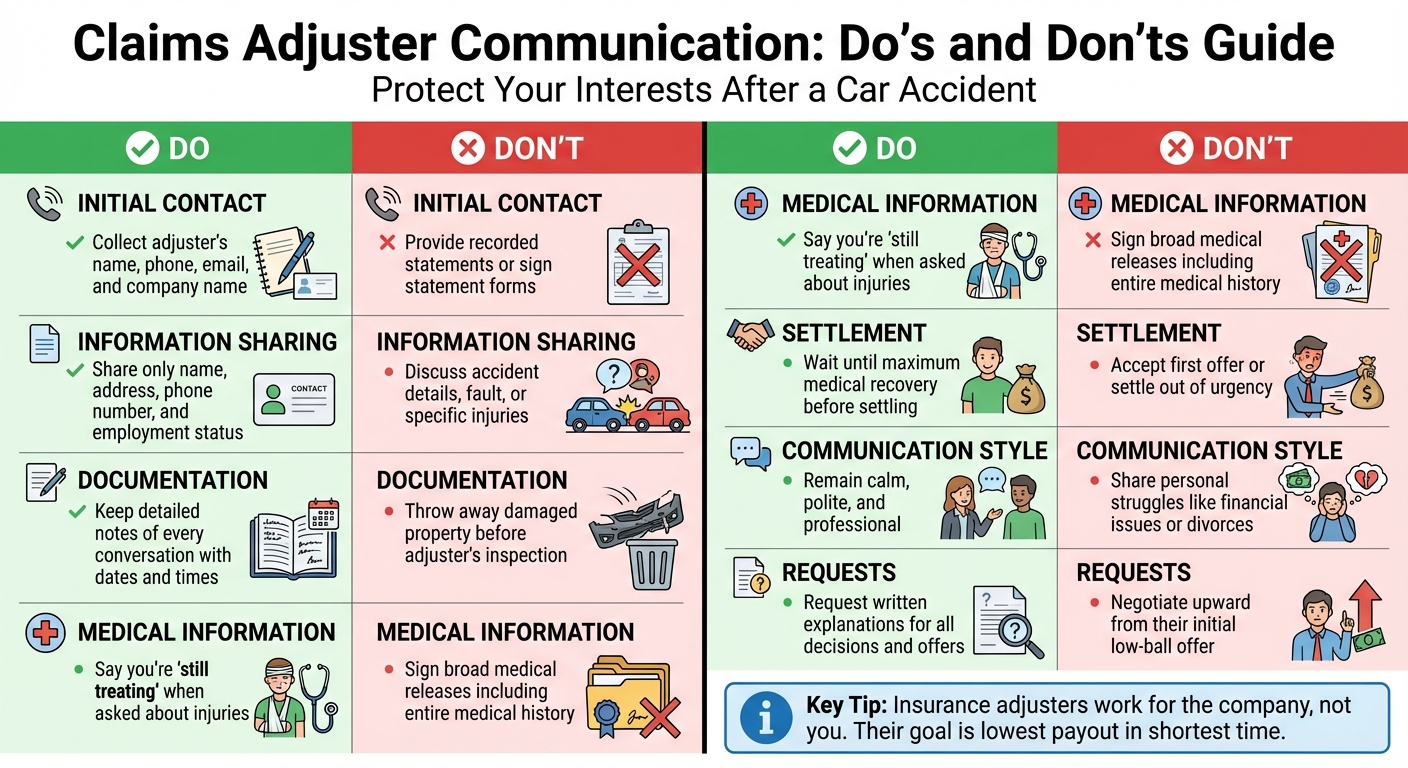
Claims Adjuster Communication Do's and Don'ts Guide
What to Do Before Contacting a Claims Adjuster
Gather Your Documentation
Before you reach out to a claims adjuster, make sure you've collected all the necessary paperwork and information. Start with the basics: jot down the date, time, and location of the accident, as well as details about the weather and road conditions. Take date-stamped photos of the accident scene, including vehicle damage, license plates, skid marks, debris, and traffic signals.
Next, gather details about everyone involved. This includes names, addresses, phone numbers, and insurance information (company name and policy number) for all drivers, along with the make, model, and year of their vehicles. Be sure to note the police report number, as well as the name and badge number of the responding officer. If there were witnesses, collect their contact information too.
You'll also need to organize your medical records and bills. This includes receipts for hospital visits, prescriptions, ambulance services, and physical therapy. Don’t forget repair estimates, receipts for any out-of-pocket expenses (like rental cars or taxis), and a statement from your employer about lost wages. Keep in mind that obtaining a copy of the police report might cost around $20.
| Category | Documents to Gather |
|---|---|
| Identification | Policy number, your full name, address, and employer details |
| Legal/Official | Police report number, officer’s badge number, witness contact information |
| Medical | Hospital bills, pharmacy receipts, physical therapy records, radiology reports |
| Financial | Repair estimates, rental car receipts, lost wage statements |
| Visual | Date-stamped photos of the scene, vehicle damage, and visible injuries |
Jason Turchin, Esq., a Personal Injury Attorney, highlights the importance of keeping thorough records:
"Part of claim settlement is to try and make you whole, so you should keep proof of any out-of-pocket expenses such as medical bills, prescription co-payments, vehicle repairs or rental cars".
Additionally, keep a daily journal to document how the accident has affected your life. This can include physical pain, missed workdays, and any limitations on your usual activities. Such a record can help when negotiating non-economic damages like pain and suffering. If you have dashboard camera footage, it could also serve as valuable evidence to support your claim.
Once your documentation is ready, it’s time to prepare for the conversation.
Plan Your Conversation
Think carefully about what you’ll say - and what you won’t. When speaking with the adjuster, stick to the basics: your name, address, phone number, and key accident details like the date, time, and location. Ask for the adjuster’s contact information and send any detailed evidence in writing to avoid verbal misunderstandings.
Before making the call, gather the adjuster’s name, phone number, email address, the insurance company they represent, and the name of the insured party. Keep all your documents organized in a dedicated claim file, including letters, medical bills, and receipts. Have your policy number and evidence within arm’s reach during the call.
Politely refuse any requests for recorded statements. You’re not legally required to provide one, and doing so could lock you into a verbal account that might later work against you. Instead, request written confirmations for any agreements or instructions to avoid potential disputes down the line.
Now, let’s look at common pitfalls to avoid, or explore our car accident guides for more detailed advice.
Mistakes to Avoid
Avoid contacting the adjuster when you’re upset or unprepared. Without proper organization, your communication might come across as chaotic, leading to unnecessary delays. Also, steer clear of statements like "I’m sorry" or admitting partial fault - these could be used as admissions of liability, which might hurt your claim.
Don’t speculate about details you’re unsure of. Guessing about speeds, distances, or the extent of injuries before a full medical evaluation can lead to inconsistencies. Adjusters might use these to question your credibility. As Morris Law warns:
"Insurance adjusters are trained to get claimants to admit fault for the accident or say something that would jeopardize their claim".
Keep personal details to a minimum. Sharing information about your work schedule, income, or personal life could give the adjuster ammunition to undervalue your claim. If you’re injured, seek medical attention immediately. Jason Turchin, Esq., advises:
"If you are hurt, you should follow up with a medical professional or get emergency care right away. Delays in medical care could hurt your case. Insurance companies may argue that your delay in treatment caused you further harm".
Lastly, make sure you understand your policy’s coverage limits, exclusions, and filing deadlines. Missing a deadline or exceeding the statute of limitations could mean losing your right to compensation entirely. This is especially critical in states like Louisiana, where the statute of limitations is only one year.
sbb-itb-6a9d141
Do's and Don'ts When Talking to Claims Adjusters
How to Communicate Clearly
Once you've done your pre-call prep, focus on communicating in a way that's clear and factual. Start every conversation by noting down vital details: the adjuster's full name, direct phone number, email, the insurance company, and the insured party's name. This ensures accountability throughout the process.
When describing the accident, stick to the basics: where and when it happened, the type of accident, the vehicles involved, and any witnesses. Share only essential personal details like your full name, address, phone number, and basic employment information - your job type and employer. Stay calm and professional, even if you're frustrated.
If you're presented with a low settlement offer, ask for a written, itemized breakdown of how they arrived at that figure. If there's a disagreement or denial, such as a total loss dispute, request that the adjuster cite the specific policy language backing their decision. As David Goguen, J.D., points out, live phone calls can pose risks:
"The adjuster might use a live call to try to get you to say something about the accident or your injuries that could hurt your claim, or that might be difficult to walk back later on."
For injury-related questions, use phrases like "I am still treating" rather than going into detail. This approach helps protect you from inadvertently leaving out symptoms that could emerge later.
Keep Records of All Communication
Organize all accident-related documents - letters, notices, medical bills, repair receipts - into a single claim file. Keep a detailed log of every interaction with the adjuster, noting the date, time, their name, key discussion points (including monetary figures or policy references), and follow up in writing immediately.
After each phone call, send a brief email summarizing what was discussed and agreed upon. Always get written confirmation for settlement offers, coverage decisions, and repair approvals. Charles R. Gueli, Esq., underscores the importance of documentation:
"Notes used to support your auto insurance claim can be called into evidence, where they will be read by the judge, jury, and the at-fault driver's attorney."
Track every piece of correspondence - mail or email - between you and the insurance company, including medical authorization forms and notification letters. Save physical or digital records of all out-of-pocket expenses, such as rental cars, medical supplies, and even mileage for doctor visits.
What Not to Say or Do
Avoid admitting fault or using apologetic language. Statements like these can be used to assign liability and reduce your settlement. Similarly, steer clear of injury-related comments like "I'm fine", "It's okay", or "I'm not hurt", as injuries might not be immediately apparent and such remarks could weaken your claim later.
Stick to the facts and avoid speculation about things like vehicle speeds or the other driver's actions. Any inconsistencies could damage your credibility. Charles R. Gueli, Esq., advises against oversharing personal struggles:
"Never confide in an insurance adjuster. They don't need to know you're going through a divorce, caring for an elderly parent, or struggling financially. Your difficulties signal that you'll settle for less, out of desperation."
Politely decline requests to record phone calls. You are not legally obligated to agree, and verbal statements can be less precise than written ones. Never disclose the minimum amount you'd accept for your claim, and avoid signing broad medical release forms that grant access to unrelated medical records.
| Topic | Appropriate | Avoid |
|---|---|---|
| Accident Details | "The accident happened at [Location] on [Date]." | "I think I might have been distracted", or "I'm sorry." |
| Injury Status | "I am still treating with my doctors." | "I'm feeling fine today", or "My back only hurts a little." |
| Recorded Statements | "I prefer to provide all necessary information in writing." | "Yes, you can record this conversation for your records." |
| Settlement Offers | "Please provide a written, itemized explanation for this offer." | "I really need this money right now to pay my bills." |
| Policy Disputes | "Which specific policy provision are you referring to?" | "I guess I don't understand how insurance works." |
It's worth noting that initial settlement offers are usually much lower than the true value of your claim. Insurance adjusters often reach out quickly - within days or weeks of an incident - to push for a low-value settlement. Take your time, verify everything in writing, and don't let pressure tactics rush you into accepting less than you deserve.
Use these guidelines as a solid foundation for navigating your negotiations effectively.
How to Handle Negotiations and Disagreements
Best Practices for Negotiating Your Claim
Once you’ve organized all your documentation, it’s time to focus on dealing with the other driver's insurance and negotiating effectively. Start by setting a private minimum settlement amount - your bottom line. This figure acts as your boundary, but keep it to yourself. Never disclose it to the adjuster.
When faced with a low offer, resist the urge to negotiate upward from their starting point. Doing so can legitimize their low-ball figure and weaken your position. Instead, stick to the amount outlined in your original demand letter. If the adjuster presents a low offer, ask for an itemized explanation of how they arrived at that number. Use this as an opportunity to counter with small, incremental adjustments while relying on your documented evidence to back up your stance. Take detailed notes on their reasoning so you can prepare a strong, fact-based rebuttal. As Charles Crain, an attorney at UC Berkeley School of Law, puts it:
"If you show the adjuster you are making a good-faith claim, you will likely get a good-faith settlement offer in return."
When discussing pain and suffering, include specific examples of how the injury has disrupted your life. For instance, mention not being able to care for your child or missing meaningful family gatherings. These personal details make your claim for general damages more compelling.
Patience is another key tactic. Avoid accepting the first offer too quickly. Waiting a few days before responding shows you’re thoughtful and not acting out of urgency. And once you’ve reached a verbal agreement, immediately confirm the details in writing, including the settlement amount, coverage, and payment timeline.
Mistakes to Avoid During Disputes
It’s crucial to keep your emotions in check during disputes. Losing your temper or becoming confrontational can damage your credibility and make the adjuster less likely to take your concerns seriously. Treat the negotiation as a professional transaction - stay calm, polite, and focused.
Never settle before you’ve fully recovered. Accepting an offer while still undergoing treatment is risky because new symptoms could appear later. Once you sign a release, you can’t reopen the claim to cover additional costs. Similarly, avoid weakening your position by lowering your demand before the adjuster has responded to your previous counteroffer.
Pay close attention to any unexplained deductions in repair or valuation estimates. For example, if the adjuster reduces your settlement because your medical bills were covered by health insurance or you used sick leave to cover lost wages, challenge it. Many states have a collateral source rule that prohibits such deductions. If you feel negotiations are stalling or the adjuster is acting in bad faith, escalate the situation. Request to speak with their supervisor or consider filing a complaint with your state’s insurance board.
Top 10 Rules For Collision Repair and Insurance Adjuster Negotiation
Quick Reference Checklist
Use this checklist as a guide for every interaction you have with your claims adjuster.
| Category | Do | Don't |
|---|---|---|
| Initial Contact | Collect the adjuster's name, phone number, email, and company name. | Provide recorded statements or sign any statement forms. |
| Information Sharing | Share only your name, address, phone number, and employment status. | Discuss details about the accident, fault, or specific injuries. |
| Documentation | Keep detailed notes of every conversation, including dates and times. | Throw away damaged property before the adjuster's inspection. |
| Medical Information | If asked about injuries, say you're "still treating." | Sign broad medical releases that include your entire history. |
| Settlement | Wait until you've reached maximum medical recovery. | Accept the first offer or settle out of urgency. |
| Communication Style | Remain calm, polite, and professional. | Share personal struggles like financial issues or divorces. |
| Requests | Request written explanations for decisions and offers. | Negotiate upward from their initial low-ball offer. |
Alongside this checklist, keep a few essential tips in mind. Verify that the adjuster is properly licensed in your state before engaging with them. If you're asked to sign a medical release, ensure it only applies to injuries related to the accident.
As David Goguen, J.D., from the University of San Francisco School of Law, points out:
"The insurance adjuster has their company's best interest in mind, not yours. Their objective is to get you to accept the lowest amount of money possible in the shortest amount of time".
Always confirm key details in writing to establish clear and well-documented boundaries.
Where to Get Help with Your Claim
Navigating insurance claims can feel overwhelming, but the right resources can make the process much smoother.
Personal injury attorneys are a key ally when dealing with serious injuries, disputes over fault, or uncooperative insurers that rely on "delay, deny, defend" tactics. For additional support, non-profit organizations like United Policyholders offer free guides to help you understand your rights as a policyholder and recognize common insurer strategies. Most insurance companies also provide customer portals, where you can track your claim’s progress and submit necessary documents directly to your adjuster.
If your claim involves vehicle damage, tools like negotiation worksheets and evidence checklists can help you stay organized. These resources are particularly useful for documenting bills, lost wages, and communication records for smaller claims.
Among the many resources available, one service stands out for handling vehicle-related claims.
Collision Help | Nationwide Accident Help
For vehicle repair, insurance claims, and total loss disputes, Collision Help | Nationwide Accident Help offers specialized support to ensure you’re effectively communicating with adjusters. Their step-by-step guidance simplifies the claims process.
Through their secure platform, you can upload clear, multi-angle photos of your vehicle's damage. Within 24 hours, you’ll receive a detailed damage assessment and a straightforward repair plan. The best part? The initial evaluation is free, giving you professional insights before making critical decisions about your claim.
FAQs
What should I avoid saying when speaking with a claims adjuster?
When dealing with a claims adjuster, it’s crucial to steer clear of admitting fault or making guesses about the accident or your injuries. Phrases like "I think" or "I'm not sure" can easily be taken out of context and used against you.
Stick to the essentials - don’t offer unnecessary details about the incident or your health, and avoid sharing personal opinions. Also, keep quiet about whether you have legal representation. It’s equally important not to accept settlement offers or hand over your medical records without first seeking professional advice. Keeping your responses concise and to the point is key to safeguarding your claim.
What’s the best way to negotiate a settlement with a claims adjuster?
To negotiate successfully, begin by collecting all the necessary documentation. This might include your insurance policy, photos showing the damage, repair estimates, and any related medical records, if applicable. Use this evidence to support a well-thought-out counteroffer that’s both clear and reasonable.
Keep track of all interactions - whether through emails, phone calls, or written correspondence - and stay calm and professional at all times. Persistence is important, but steer clear of admitting fault or making statements that could undermine your claim. With preparation and patience, you’ll be better positioned to secure a fair outcome.
Why should I keep a record of all communications with a claims adjuster?
Keeping track of every interaction with a claims adjuster is a smart way to protect yourself and keep the claims process running smoothly. It can help avoid confusion, provide solid evidence if disagreements come up, and serve as a reliable record of any agreements or statements.
Whether it’s a phone call, email, or other communication, documenting everything ensures your claim stays on track and minimizes the chance of your words being misunderstood or misrepresented. This straightforward habit can have a significant impact on the final outcome of your claim.