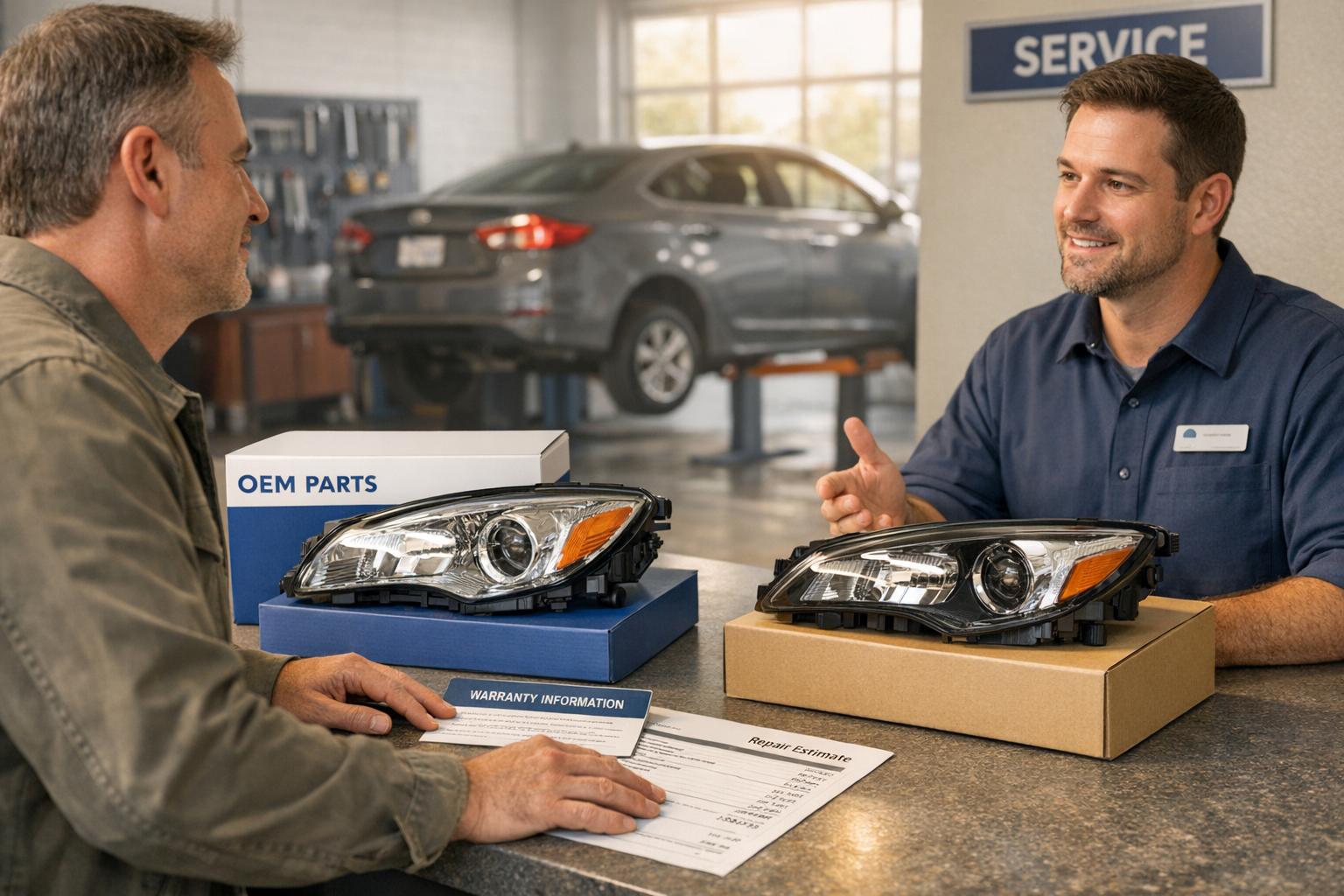
Your Rights When Insurers Use Aftermarket Parts
When your car needs repairs after an accident, insurers often suggest using aftermarket parts instead of original manufacturer (OEM) parts. These third-party components are cheaper - sometimes up to 50% less - and help insurers save billions annually. However, this cost-saving measure can affect your car's resale value, warranty, and even repair quality.
Here’s what you need to know:
- Aftermarket vs. OEM: Aftermarket parts are made by third-party manufacturers and may not fit or perform as precisely as OEM parts. While some are certified for quality, others may fall short.
- State Laws: Most states require insurers to disclose when aftermarket parts are used. Some states mandate your consent, especially for newer vehicles.
- Federal Protections: The Magnuson-Moss Warranty Act prevents manufacturers from voiding your warranty solely because of aftermarket parts unless they cause damage.
- Your Options: You can request OEM parts, but you may need to pay the price difference. If dissatisfied, file complaints with your state insurance department or escalate through mediation or arbitration.
Knowing your rights helps you make informed decisions, protect your vehicle’s value, and challenge insurers when necessary.
This is why aftermarket parts are cheap - OEM vs Aftermarket Parts
sbb-itb-6a9d141
What Are Aftermarket Parts and Why Do Insurers Use Them?
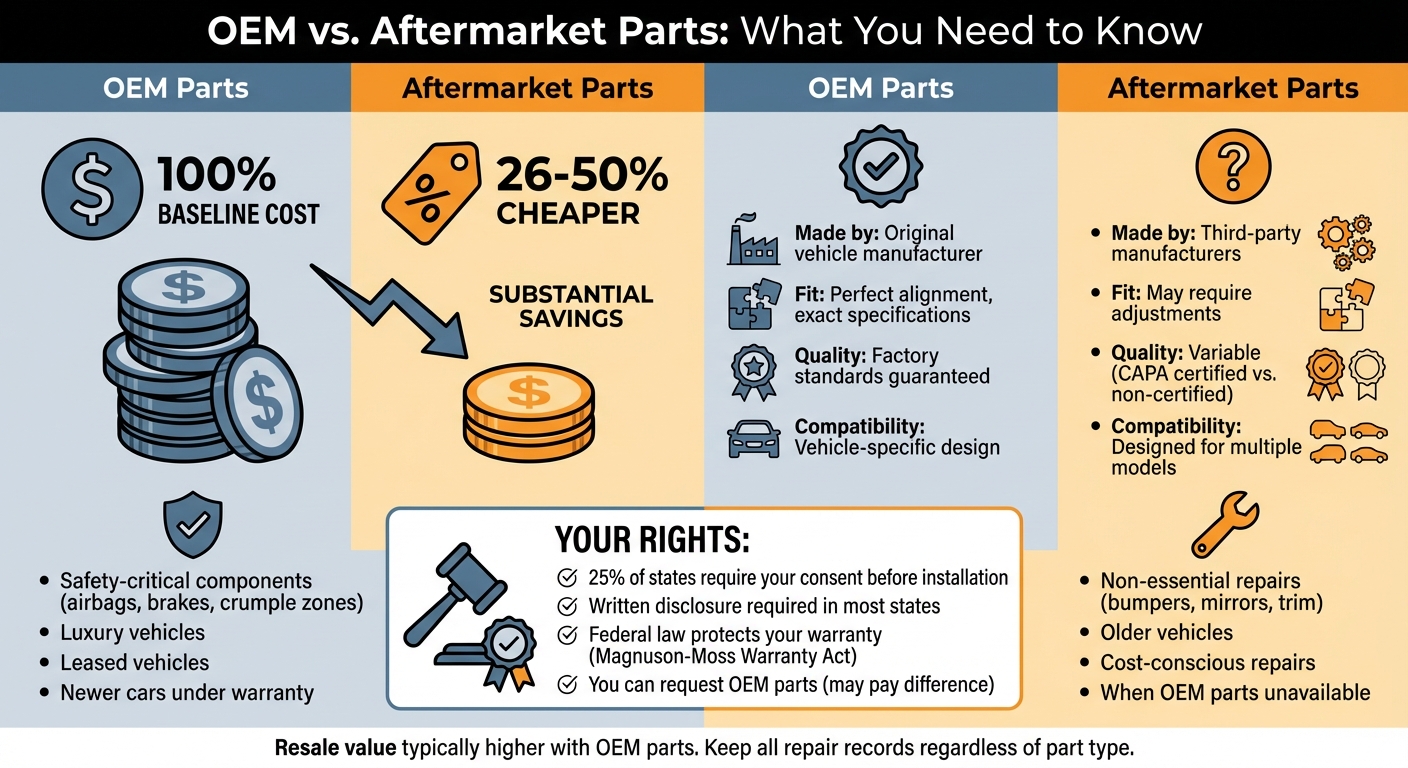
OEM vs Aftermarket Auto Parts: Cost, Quality, and Consumer Rights Comparison
If your repair estimate mentions "aftermarket parts", it means your insurer wants to use components made by third-party manufacturers instead of parts from your vehicle's original maker. While these parts are designed to function like OEM (Original Equipment Manufacturer) components, they come from independent producers.
The big draw here is the price. Aftermarket parts are usually 26% to 50% cheaper than OEM parts. This cost difference comes from reduced brand premiums and designs that often fit multiple vehicle models.
OEM vs. Aftermarket Parts: Key Differences
Aside from price, the main differences between OEM and aftermarket parts involve fit, quality, and performance. OEM parts are made by your car's manufacturer or their approved suppliers and are identical to the parts your vehicle originally came with. Aftermarket parts, on the other hand, are created by independent companies and aim to replicate OEM components, though they may vary slightly.
Fit is one area where discrepancies can arise. OEM parts are tailored to your specific vehicle, ensuring perfect alignment with mounting points and electrical connections. Aftermarket parts, designed for broader compatibility, might not fit as precisely. Some match factory specifications perfectly, while others may need adjustments during installation.
Quality is another consideration. Many aftermarket parts are certified by the Certified Automotive Parts Association (CAPA), which ensures they meet safety and quality standards comparable to OEM parts. However, not all aftermarket components are certified, meaning quality can range from budget-friendly to premium-grade.
As Emily Delbridge, a licensed insurance agent, points out: "The only difference is who makes the parts, because both types are regulated and inspected".
For safety-critical components like airbags, brakes, or structural crumple zones, experts often recommend sticking with OEM parts. These systems demand precise tolerances to integrate seamlessly with your car’s safety features. For non-essential repairs - like bumpers, mirrors, or trim - aftermarket parts are generally a fine choice.
Why Insurance Companies Prefer Aftermarket Parts
The differences between these parts shed light on why insurers often favor aftermarket options. The main reason? Lower repair costs. By using aftermarket parts, insurers reduce their claim payouts, saving money in the process.
But it’s not just about saving on claims.
According to the Insurance Information Institute, "The introduction of aftermarket parts has also forced down the price of OEM parts by creating competition in the marketplace".
This competition benefits consumers by keeping both OEM and aftermarket prices in check.
Another factor is availability. Aftermarket parts are often easier to find, especially for older cars where OEM components may no longer be in production. Faster access to parts can mean quicker repairs and less downtime for your vehicle.
Insurers may also argue that using aftermarket parts helps keep premiums lower. While it’s true that reduced claim costs could lead to more competitive rates, the savings don’t always make their way directly to policyholders. Keep in mind, you have the right to question the use of aftermarket parts if you’re concerned about their performance or safety.
Your Legal Rights When Aftermarket Parts Are Used
If your insurer includes aftermarket parts in a repair estimate, both state and federal laws are in place to protect your rights. These laws ensure insurers handle such parts transparently and require clear disclosure before any repairs begin. Here's a closer look at the protections available.
State Laws on Aftermarket Parts
In most states, insurers must provide written disclosure when a repair estimate includes non-OEM (original equipment manufacturer) parts. This means the estimate must clearly indicate which parts are not made by your vehicle's original manufacturer.
About 25% of states require your explicit consent before installing aftermarket parts. In these states, simply notifying you isn't enough - your approval is mandatory. These consent rules often apply to newer vehicles, typically those less than two years old or with fewer than 30,000 miles on the odometer.
California offers some of the strongest protections for consumers. Insurers in the state must provide dual estimates - one using OEM parts and another using aftermarket parts - allowing you to compare costs. If you decide to go with OEM parts, you’ll need to pay the price difference, but at least the choice is yours.
Utah recently updated its laws to strengthen consumer protections. In March 2026, the Utah House passed H.B. 119, which requires insurers to notify policyholders at the time of policy issuance and renewal that aftermarket parts may be used. Starting October 1, 2026, repair estimates in Utah must clearly label non-OEM parts and clarify that warranties for these parts come from the part manufacturer, not the vehicle maker.
Federal Laws That Apply to Aftermarket Parts
Federal law also provides important safeguards. The Magnuson-Moss Warranty Act ensures that manufacturers cannot void your vehicle's warranty simply because an aftermarket part was installed - unless they can prove the part caused the issue.
"A vehicle manufacturer cannot void the warranty of your vehicle due to an aftermarket part unless they can prove that the aftermarket part was the cause of or contributed to the failure of the vehicle (15 U.S.C. 2302 (C))."
If a dealer claims your warranty is void because of an aftermarket part, ask for written proof showing how that part caused the problem. The responsibility to provide this evidence lies with them - not you.
How to Challenge Aftermarket Parts in Your Repair Estimate
If you're not satisfied with aftermarket parts listed in your repair estimate, there are steps you can take to push back. Here's how to make your case effectively.
Get Multiple Repair Estimates
Start by collecting at least three repair estimates from independent shops. These shops may highlight quality issues or recommend different parts than those in the original estimate. Compare these estimates to pinpoint differences in parts recommendations and overall costs. To strengthen your argument, choose repair shops certified by the manufacturer of your vehicle - they're more likely to emphasize the need for OEM (Original Equipment Manufacturer) parts to ensure proper restoration. If inconsistencies persist, bring these comparisons to your insurer’s attention.
Talk to Your Insurance Adjuster About Your Concerns
The next step is communicating directly with your insurance adjuster. Be clear about your preference for OEM parts and explain your concerns about safety, how aftermarket parts could affect your car's resale value, and any potential impacts on warranties. Keep detailed notes of your conversations, including dates and key points discussed. If you're not getting anywhere, don’t hesitate to ask for the issue to be escalated to a supervisor. Keep in mind that some states, like California, allow you to insist on OEM parts, though you may need to cover the cost difference.
Get Expert Help
If you're still facing issues, consider reaching out to professionals for guidance. Services like Collision Help | Nationwide Accident Help can provide free evaluations. Simply upload photos of your vehicle damage, and within 24 hours, you'll receive expert advice. These experts can review your repair estimate, point out concerns with aftermarket parts, and give you a tailored plan to challenge your insurer’s decision effectively.
What to Do When Your Insurer Insists on Aftermarket Parts
If your insurer won’t budge on using aftermarket parts, even after internal discussions, it might be time to explore more formal steps to resolve the issue.
File a Complaint with Your State Insurance Department
Every state has an insurance regulatory body to ensure that insurance companies follow the rules. If your insurer refuses to use OEM parts or doesn’t provide a written explanation for their decision, you can file a formal complaint with this agency. This process may trigger an official review of your situation.
When submitting your complaint, make sure to include all relevant documentation. This might include:
- A copy of your policy, especially any sections about "choice of parts" or "pre-accident condition."
- All repair estimates you’ve received.
- Logs of communication with your insurer, including dates and the names of the adjusters you spoke with.
- Any written denials or justifications provided by your insurance company.
If the complaint doesn’t lead to a resolution, you can explore other dispute resolution methods.
Use Mediation or Arbitration
Mediation and arbitration are alternatives to taking your case to court. In mediation, a neutral third party helps both sides reach a voluntary agreement. Arbitration, on the other hand, involves an arbitrator who makes a binding decision.
Arbitration often moves faster than court cases, with dates available in just a few months. It’s also less costly and follows simpler procedures. An added benefit is that you can often select an arbitrator with expertise in auto repairs or insurance disputes. This ensures that technical details - like the differences between OEM and aftermarket parts - are properly considered.
Keep in mind that binding arbitration is final, with very limited options for appeal. Before pursuing this route, check your insurance policy for any clauses that require arbitration for disputes.
How Aftermarket Parts Affect Your Vehicle's Value and Warranty
Choosing between OEM (Original Equipment Manufacturer) and aftermarket parts doesn’t just impact repair costs - it also plays a role in your car's resale value and warranty coverage.
Impact on Resale Value
OEM parts tend to protect resale value. Both dealerships and private buyers often favor vehicles repaired with OEM components because these parts match the original specifications and meet the manufacturer's quality benchmarks. According to First Aid Collision:
"Vehicles repaired with OEM parts typically command higher resale values than those with aftermarket components".
While aftermarket parts are generally 20–40% cheaper than OEM parts, the latter can sometimes cost 50–100% more. However, poorly fitted aftermarket parts may cause issues like uneven gaps, wind noise, or mismatched paint. These flaws can make potential buyers hesitant. This is especially true for luxury cars and leased vehicles, where sticking to OEM parts is often the safer choice.
However, not all aftermarket modifications hurt your car’s value. Certain upgrades - like enhanced suspension systems or improved sound systems - can actually increase it. Kim Porter, Senior Writer at Experian, notes:
"A part that improves your car's performance or safety may increase its value, while a highly custom or poorly installed part could have the opposite effect".
To safeguard your car’s value, keep all receipts, installation records, and warranty certificates for aftermarket parts. Holding onto the original OEM components can also reassure appraisers and future buyers.
But resale value isn’t the only thing to consider - your choice of parts can also influence your warranty, future claims, or even a total loss dispute.
Warranty and Future Claims Concerns
Using aftermarket parts doesn’t automatically void your manufacturer's warranty. Federal law ensures your warranty remains valid unless it’s proven that the aftermarket part caused the failure. The Federal Trade Commission explains:
"Under the Magnuson-Moss Warranty Act, it is illegal for companies to void your warranty or deny coverage under the warranty because an aftermarket part is installed".
As EV Sportline clarifies:
"The dealer must prove the aftermarket parts caused the failure at hand".
For example, if you install aftermarket brake pads and later experience a transmission issue, the manufacturer cannot deny your transmission warranty claim based on the brake pads. However, if the brake pads are defective or improperly installed and damage your brake system, the warranty for that specific repair could be voided. The rest of your warranty, however, would remain unaffected.
Insurance companies often lean toward aftermarket parts because they help reduce claim costs. To avoid complications with future claims, maintain detailed records showing that all repairs were done professionally. For more information on navigating the insurance process, see our car accident guides. If a dealer tries to deny a warranty claim due to aftermarket parts, ask for written proof that the parts caused the issue.
Conclusion
Knowing your rights when insurers suggest aftermarket parts gives you more control over your vehicle's repair process. You're entitled to a written estimate that specifies whether parts are aftermarket or used, and repair shops can't proceed without your explicit approval. Always inspect your vehicle at the shop to verify the repairs and parts before making payment.
If you're dissatisfied with the repair quality, start by discussing your concerns with the shop's management. Many disputes can be resolved through open communication. If that doesn't work, state agencies like the DMV offer mediation services, which resolve about 50% of auto repair complaints. Be sure to keep detailed records of all interactions and repairs - these can be critical if you need to file a complaint or protect your vehicle's resale value.
The New York State Department of Motor Vehicles emphasizes the importance of being proactive:
"The Repair Shop Act works best when consumers take the time to shop wisely for auto repairs, keep records of their dealings with shops, and discuss repairs with shop management to avoid misunderstandings".
This principle applies across the country - good documentation and clear communication are your best allies.
If internal discussions don't resolve the issue, seeking expert assistance can make a difference. As Kash Legal Group points out:
"Consulting with an attorney doesn't always mean filing a lawsuit; often, a letter from an attorney can prompt the insurer to reconsider their stance".
For particularly tricky claims or disputes over parts, Collision Help offers free evaluations. You can upload photos of the damage and receive expert feedback within 24 hours.
Take charge of the process - verify repairs, document everything, and don't hesitate to seek expert advice to ensure fair treatment and quality results.
FAQs
Can I refuse aftermarket parts on my repair estimate?
Yes, you can ask for OEM (Original Equipment Manufacturer) parts instead of aftermarket parts when getting a repair estimate. Sometimes, your insurer might provide estimates for both options, but you could be responsible for covering the price difference. Review your insurance policy and state regulations to understand your rights and any potential costs.
How do I confirm what parts were actually installed on my car?
When reviewing a repair estimate or invoice from the shop, look closely at the listed parts. These documents should include details about the parts used, such as the manufacturer. In many states, repair shops are required to clearly label any non-OEM (Original Equipment Manufacturer) parts. If this information isn’t clear, don’t hesitate to ask the shop to specify which parts were installed.
Will aftermarket parts affect my car’s warranty or future claims?
Aftermarket parts typically won’t void your car’s warranty. Thanks to the Magnuson-Moss Warranty Act, the manufacturer has to prove that the aftermarket part directly caused the problem in question to deny warranty coverage. However, it’s always a good idea to review your warranty terms carefully to understand any specific conditions or limitations.